


The Calven MCP connector routes your AI agent's tool calls to Calven's own MCP server through Scalekit. Each user connects their own Calven access token once, and Scalekit sends it with every call, so your agent never handles credentials. It comes with 16 tools.
- Tools
- 16
- What they doRead · write · destructive
- 13 · 3 · 013 read3 write0 destructive
- Users sign in with
- Access token
Setup
Install the SDK
Terminal window npm install @scalekit-sdk/node dotenvTerminal window pip install scalekit-sdk-python python-dotenvSet your credentials
Add your Scalekit credentials to your
.envfile. Find values in app.scalekit.com > Developers > API Credentials..env SCALEKIT_ENVIRONMENT_URL=<your-environment-url>SCALEKIT_CLIENT_ID=<your-client-id>SCALEKIT_CLIENT_SECRET=<your-client-secret>Create the Calven MCP connection
In AgentKit > Connections, create a Calven MCP connection. The name you give it is the
connection_nameyour code passes. See Configure connections.Console steps with screenshots
Register your Calven API key with Scalekit so it can authenticate requests to the Calven MCP server on behalf of your users. Use this connection when your client can’t run the Calven OAuth sign-in and needs a header-based key.
-
Generate a Calven API key
-
Sign in to Calven and go to Settings > API & MCP.
-
Under Optional API key, click Generate (or Regenerate if a key exists) and copy the key. It starts with
cmcp_.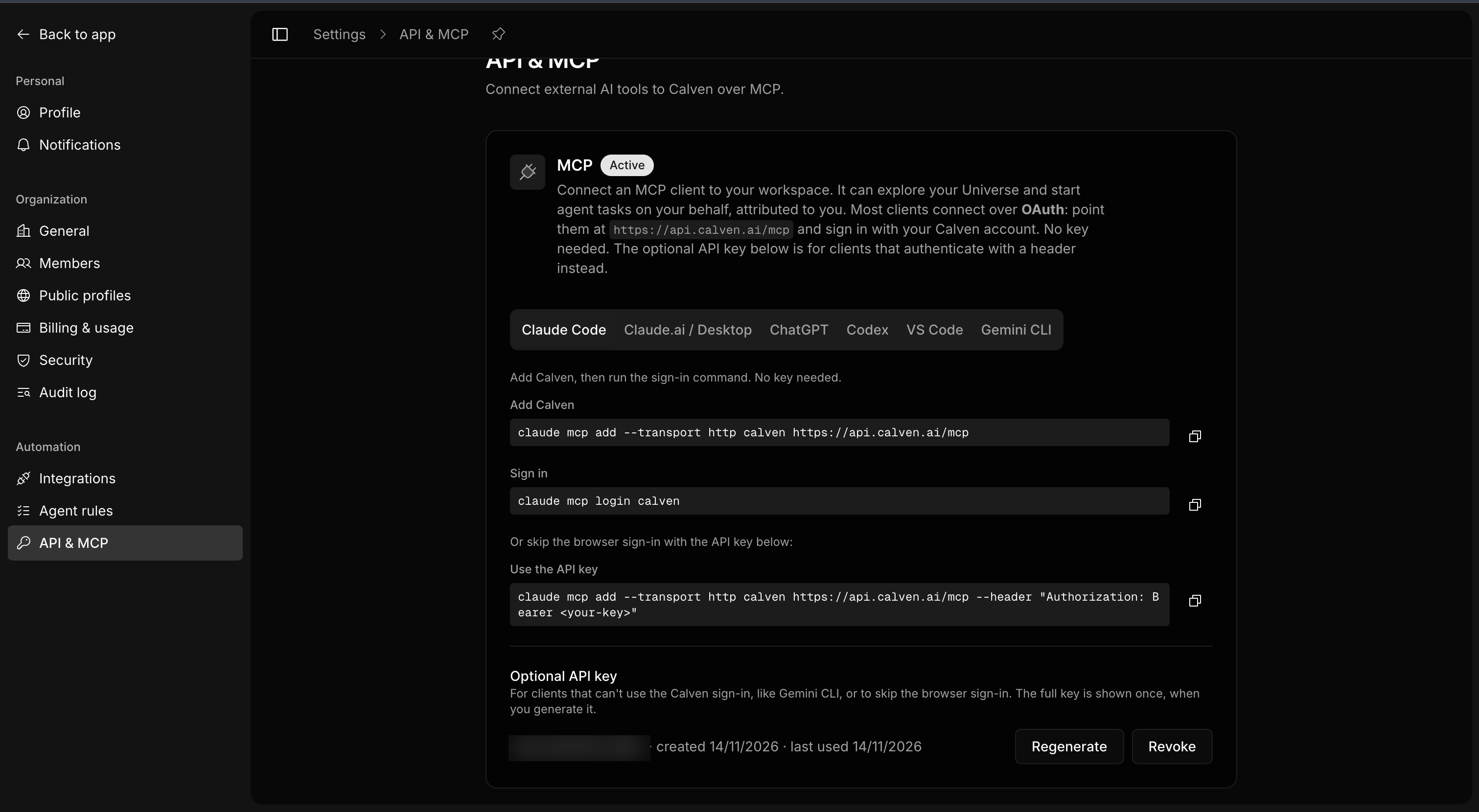
-
-
Create a connection in Scalekit
- In the Scalekit dashboard, go to AgentKit > Connections > Create Connection.
- Search for Calven MCP and click Create.
- Note the Connection name. Use it as
connection_namein your code (for example,calvenmcp).
-
Add a connected account
- Open the connection, click Connected Accounts > Add account.
- Enter Your User’s ID and the API Key, then click Save.
To add the account from your backend:
await scalekit.actions.upsertConnectedAccount({connectionName: 'calvenmcp',identifier: 'user_123',credentials: { token: 'cmcp_...' },});scalekit_client.actions.upsert_connected_account(connection_name="calvenmcp",identifier="user_123",credentials={"token": "cmcp_..."},)
-
Authorize a user and make your first call
quickstart.mts import { ScalekitClient } from '@scalekit-sdk/node'import 'dotenv/config'import { createInterface } from 'node:readline/promises'const scalekit = new ScalekitClient(process.env.SCALEKIT_ENVIRONMENT_URL,process.env.SCALEKIT_CLIENT_ID,process.env.SCALEKIT_CLIENT_SECRET,)const actions = scalekit.actionsconst connector = 'calvenmcp'const identifier = 'user_123'// Generate an authorization link for the userconst { link } = await actions.getAuthorizationLink({ connectionName: connector, identifier })console.log('Authorize Calven MCP:', link)const rl = createInterface({ input: process.stdin, output: process.stdout })await rl.question('Press Enter after authorizing...')rl.close()// Make your first callconst result = await actions.executeTool({connector,identifier,toolName: 'calvenmcp_get_competitor',toolInput: {},})console.log(result)Terminal window npx tsx quickstart.mtsquickstart.py import osfrom scalekit import ScalekitClientfrom dotenv import load_dotenvload_dotenv()scalekit_client = ScalekitClient(env_url=os.getenv("SCALEKIT_ENVIRONMENT_URL"),client_id=os.getenv("SCALEKIT_CLIENT_ID"),client_secret=os.getenv("SCALEKIT_CLIENT_SECRET"),)actions = scalekit_client.actionsconnection_name = "calvenmcp"identifier = "user_123"# Generate an authorization link for the userlink_response = actions.get_authorization_link(connection_name=connection_name,identifier=identifier,)print("Authorize Calven MCP:", link_response.link)input("Press Enter after authorizing...")# Make your first callresult = actions.execute_tool(tool_input={},tool_name="calvenmcp_get_competitor",connection_name=connection_name,identifier=identifier,)print(result)Terminal window python quickstart.pyEach user opens the link once and enters their Calven MCP server credentials there. If your app already has a user's credentials, add the account from your backend instead, as the console steps above show. See Authorize a user for the full flow and statuses.
Tools
Pass the exact name toexecute_toolcalvenmcp_get_competitorOne competitor in a single call: the row, its battlecard (how to sell against them: traps, objections, proof points), its most recent competitive signals, and the outline of its deep-dive dossier (pricing, packaging, positioning, strengths, weaknesses) with the call that reads the dossier whole.Read-onlyGet competitor
One competitor in a single call: the row, its battlecard (how to sell against them: traps, objections, proof points), its most recent competitive signals, and the outline of its deep-dive dossier (pricing, packaging, positioning, strengths, weaknesses) with the call that reads the dossier whole. Use when: a question names a specific rival, including how they price, package, position or sell. Competitor pricing lives in their dossier, not in any product brief: read it with the read_document call the result prints. Do NOT use when: you want the whole roster or a filtered feed: list_records({ kind: "competitors" }) and list_records({ kind: "competitive_signals" }) do that. Args: Pass `id` or `name`, not both. Returns: competitor { id, name, cells, battlecard, recent_signals, signals_has_more, deep_dive { asset_id, word_count, sections } }. A null battlecard or deep_dive is not published; the notes say which documents are. Example: get_competitor({ name: "Collibra" })
Inputs
idstring- The 8-character id shown in results, or a full id.
namestring- The competitor name, case-insensitive. Use instead of `id`.
calvenmcp_get_insight_detailThe rows behind one number on an Insights dashboard: the deals in a pricing bucket or loss outcome, the deals against one competitor, what buyers answered to one survey question, one AI assistant answer, the market-signal feed.Read-onlyGet insight detail
The rows behind one number on an Insights dashboard: the deals in a pricing bucket or loss outcome, the deals against one competitor, what buyers answered to one survey question, one AI assistant answer, the market-signal feed. Use when: get_insights returned a number and you need its evidence. Sections name the drill-downs they support under "Rows behind these numbers". Args: detail is one of win_loss.verbatims, win_loss.answers, win_loss.pricing_deals, win_loss.product_deals, win_loss.loss_outcome_deals, competitive_intelligence.competitor_deals, competitive_intelligence.pricing_deals, positioning.ai_answer, market_research.signals. Pass the same product and window as the get_insights call it drills into. verbatims needs group, answers needs question (a question_id), product_deals needs product. Other arguments narrow where they apply; leave verdict, bucket or outcome out to get every group, labelled. Returns: items[] (at most `limit`, max 100) and more_available with how to narrow. Deal names, amounts and buyer survey answers follow the workspace security settings. Example: get_insight_detail({ detail: "competitive_intelligence.competitor_deals", competitor: "AuditBoard", outcome: "lost" })
Inputs
detailstringrequired- Which drill-down.one of
win_loss.verbatimswin_loss.answerswin_loss.pricing_dealswin_loss.product_dealswin_loss.loss_outcome_dealscompetitive_intelligence.competitor_dealscompetitive_intelligence.pricing_dealspositioning.ai_answermarket_research.signals answerstring- ai_answer: an assistant's name (e.g. ChatGPT) or an answerId. Omit for every assistant's latest answers.
bucketstring- loss_outcome_deals: what beat us. Omit for every bucket, each row labelled.one of
competitorin_houseno_decisionunattributed competitorstring- CI details: one competitor, by name.
fromstring- First day counted, YYYY-MM-DD. Pass `to` with it.
groupstring- verbatims: a survey group with written answers, e.g. "Product".
include_untaggedboolean- With `product`: also count rows with no product tag (company-wide, or not yet tagged).default
false limitinteger- Rows to return, default 20, max 100.
loss_reasonstring- competitor_deals: one loss reason.
monthstring- competitor_deals: YYYY-MM.
offsetinteger- Rows to skip: the `next rows: offset` a previous reply printed.
outcomestring- Omit for both, each row labelled.one of
wonlost productstring- Product name (case-insensitive, as list_products prints it) or id: only rows tagged with it, like the dashboard's product chip. "untagged" alone: only rows with no product. Omit for the whole company.
questionstring- answers: a question_id.
ratinginteger- answers: one rating.
tierinteger- CI details: one tier of rivals, as the HTTP drill-down takes it: 1, 2 or 3 (the pricing_distribution pool tier_N), "emerging" or "untiered". Accepts 1, 2 or 3 (as a number) or "emerging" or "untiered".
timeframestring- Today is 2026-11-14. trailing4w / trailing12m (default) = this week / month so far plus the 3 / 11 before; thisQuarter, thisYear = so far; lastMonth, lastQuarter, lastYear = the previous complete one. Any other month or quarter ("Q2"): from + to.one of
trailing4wtrailing12mthisQuarterthisYearlastMonthlastQuarterlastYear tostring- Last day counted, YYYY-MM-DD (August 2026 = 2026-08-01 to 2026-08-31).
verdictstring- pricing_deals: less_expensive|on_par|more_expensive (win_loss), cheaper|on_par|pricier (CI). Omit for every verdict, each row labelled.
calvenmcp_get_insightsAny agent's Insights dashboard as data: the numbers each section of the tab shows (KPIs, rates, breakdowns, trends, rankings), computed exactly as the dashboard computes them.Read-onlyGet insights
Any agent's Insights dashboard as data: the numbers each section of the tab shows (KPIs, rates, breakdowns, trends, rankings), computed exactly as the dashboard computes them. Each comparable KPI comes with its change against the period before. Use when: a question is about totals, rates, shares, trends or rankings, or any KPI tile (the `sections` parameter lists the tiles of each section): win rate, why we lose, which segment sells best (win_loss segments), ICP vs non-ICP pipeline, product gaps that cost deals, competitor momentum, customer themes, messaging drift, how AI describes us. Do NOT use when: "how are we doing" or a periodic review across dashboards (get_insights_overview first); the individual rows behind a number (get_insight_detail, or list_records); a strategy document (get_strategy_document). Args: dashboard + optional sections (omit for every section). Window: timeframe OR from+to (both days counted), default trailing12m; positioning and messaging have no window. product: strict, like the dashboard chip. Returns: sections[] { id, title, status, data, notes, placeholders }, the window counted and the period it is compared with, the product scope, and a link to the dashboard. A KPI's `comparison` is { prior, delta, prior_n } (delta in percentage points for rates), or { reason } when it cannot be compared (never read that as no change); a KPI marked snapshot is current state, with no change; a KPI marked not_compared counts the period but has no change on purpose (it is still filling in or reads today's state), so never compute one from other periods. Placeholders are widgets with no numbers behind them: say there is no number, never estimate one. Cite the sample (n) beside every rate. Example: get_insights({ dashboard: "competitive_intelligence", sections: ["performance"], timeframe: "thisQuarter" })
Inputs
dashboardstringrequired- Which Insights tab. win_loss: win rate, pipeline won/lost, why we win and lose, segments; win_loss_program_health: the survey program; competitive_intelligence: per-competitor performance, battlecards, influenced revenue; icp: ICP fit, win predictors; voice_of_customer: customer themes, signals, quotes; persona: buying group, multi-threading; positioning and messaging: consistency, drift, AI perception; market_research: opportunities, trends, signals; product_intelligence: product gaps that cost deals, drift.one of
win_losswin_loss_program_healthcompetitive_intelligencevoice_of_customericppersonapositioningmessagingmarket_researchproduct_intelligence fromstring- First day counted, YYYY-MM-DD. Pass `to` with it.
include_untaggedboolean- With `product`: also count rows with no product tag (company-wide, or not yet tagged).default
false liststring- With one section: the rest of a list a reply cut, by the name its header prints ("next rows: list: …"), 200 rows from `offset`.
offsetinteger- With `list`: rows to skip, as the cut header prints.
productstring- Product name (case-insensitive, as list_products prints it) or id: only rows tagged with it, like the dashboard's product chip. "untagged" alone: only rows with no product. Omit for the whole company.
sectionsarray- Omit for all, or ids to read only those ([KPI tiles], * no numbers): win_loss: scoreboard [Competitive win rate,Pipeline won,Pipeline lost,Sentiment],segments,buying_group,surveys_head_to_head,surveys_product,surveys_pricing_legal,surveys_sales_team,why_won_lost,deciding_forces; win_loss_program_health: scoreboard [Deals with completed win-loss,Completion rate,AI interview vs. online survey],volume,email_delivery [Bounce rate,Emails sent],response_funnel,ai_interviews [Picked the AI interview,Rated the AI interview good],respondent_experience [Rated the online survey good],enrollment_coverage [Deals enrolled,Deals analyzed],segment_coverage,timing [Median AI interview length,Median online survey time,Started but not finished]; competitive_intelligence: kpis [Competitive win rate,Influenced revenue,Battlecard coverage,Competitors in catalog],performance,showdown,market_movement [Feature parity coverage*,"Bullshit detector" flags*]; voice_of_customer: kpis [Conversations analyzed,Customer-voice signals,Product feedback signals,Analyst-hours saved],customer_signals,tied_to_revenue,quotes; icp: kpis [ICP share of wins,ICP-fit pipeline,Avg deal size,Sales cycle],expand_icp,win_predictors,reality_check; persona: kpis [Multi-threading win-rate,Single-threaded pipe,Multi-threaded pipe,Contact coverage],buying_group,persona_intelligence,keeping_honest; positioning: kpis [Positioning alignment,Drift resolved,Positioning moves],consistency,market_landscape [Perceptual map*,Differentiator defensibility*],grounded,ai_perception; messaging: kpis [Message sharpness,Customer-language fit,Messaging alignment,Evidence-backed pillars],effectiveness,quality,customer_language,field_adoption; market_research: kpis [Opportunities surfaced,Opportunities actioned,High-impact trends,Signals tracked],opportunities_trends,signal_intelligence; product_intelligence: kpis [Drift flagged,Assets synced,Unsupported claims*,Enablement coverage*],product_changes [Strengths vs gaps*,Product claims feed*],outcomes
timeframestring- Today is 2026-11-14. trailing4w / trailing12m (default) = this week / month so far plus the 3 / 11 before; thisQuarter, thisYear = so far; lastMonth, lastQuarter, lastYear = the previous complete one. Any other month or quarter ("Q2"): from + to.one of
trailing4wtrailing12mthisQuarterthisYearlastMonthlastQuarterlastYear tostring- Last day counted, YYYY-MM-DD (August 2026 = 2026-08-01 to 2026-08-31).
calvenmcp_get_insights_overviewEvery Insights dashboard's headline KPIs for one window, each comparable one with its change against the period before, plus what moved most in each ranked list, the current top loss reasons and product gaps, and which dashboards have no data.Read-onlyGet insights overview
Every Insights dashboard's headline KPIs for one window, each comparable one with its change against the period before, plus what moved most in each ranked list, the current top loss reasons and product gaps, and which dashboards have no data. Use when: "how are we doing", a monthly or quarterly review, a launch readout (with product), or one headline KPI. Each item names the get_insights section to read next. Do NOT use when: a breakdown, trend or longer ranking (get_insights; a long list says how many it shows of the total). Args: product and the window, as get_insights. Returns: kpis[] with `comparison` (as get_insights), movers[], top_loss_reasons, product_gaps (amount_at_risk covers won and lost deals: not lost revenue), availability, window and compared period. Example: get_insights_overview({ timeframe: "lastMonth" })
Inputs
fromstring- First day counted, YYYY-MM-DD. Pass `to` with it.
include_untaggedboolean- With `product`: also count rows with no product tag (company-wide, or not yet tagged).default
false productstring- Product name (case-insensitive, as list_products prints it) or id: only rows tagged with it, like the dashboard's product chip. "untagged" alone: only rows with no product. Omit for the whole company.
timeframestring- Today is 2026-11-14. trailing4w / trailing12m (default) = this week / month so far plus the 3 / 11 before; thisQuarter, thisYear = so far; lastMonth, lastQuarter, lastYear = the previous complete one. Any other month or quarter ("Q2"): from + to.one of
trailing4wtrailing12mthisQuarterthisYearlastMonthlastQuarterlastYear tostring- Last day counted, YYYY-MM-DD (August 2026 = 2026-08-01 to 2026-08-31).
calvenmcp_get_personaOne persona's row plus its deep-research canvas: pains, gains, jobs to be done, objections, messaging hooks.Read-onlyGet persona
One persona's row plus its deep-research canvas: pains, gains, jobs to be done, objections, messaging hooks. Use when: you are tailoring copy, a play or an objection response to a specific persona. Do NOT use when: you want the roster of personas: list_records({ kind: "personas" }) is the lightweight read. Args: Pass `id` or `name`, not both. Returns: persona { id, name, cells, canvas }. A null canvas means no canvas is published; the row attributes still apply. Example: get_persona({ name: "VP of Data" })
Inputs
idstring- The 8-character id shown in results, or a full id.
namestring- The persona name, case-insensitive. Use instead of `id`.
calvenmcp_get_recordOne row with its FULL cell set.Read-onlyGet record
One row with its FULL cell set. Each list_records result names the columns get_record would add; when it says none, the list line already had everything. Use when: you have a row id (or an exact name) and need everything the workspace knows about it. Do NOT use when: the row is a competitor or a persona: get_competitor and get_persona add its documents. Args: Pass one of `id`, `name` or `ids`. `id` is the short `id:` a list_records line prints (8 characters), or the full id. `name` is the exact name or title (case-insensitive); quotes, findings, drivers and claims go by id. `ids`: up to 25 rows of one kind in one call, never one call per row. Returns: record { id, kind, name, cells }, or records[] with `ids`. Agent-only bookkeeping columns are never included. Example: get_record({ kind: "trends", name: "AI governance" })
Inputs
kindstringrequired- Which curated database the row belongs to.one of
competitorscompetitive_signalspersonastrendsmarket_opportunitiesanalyst_findingsthemesquotesvendor_quotescustomer_conversationsmarket_signalsdeal_driversproduct_changesproduct_drift_findingsclaimssurveyed_dealssurvey_responsescrm_accountscrm_contactscrm_deals idstring- The 8-character id a list_records line prints, or a full id.
idsarray- Several rows of this kind at once, by the ids list_records prints. Use instead of `id`.
namestring- The exact row name, case-insensitive. Use instead of `id`.
calvenmcp_get_strategy_documentOne of the four workspace strategy documents, as published markdown.Read-onlyGet strategy document
One of the four workspace strategy documents, as published markdown. positioning = category, target, differentiation, narrative. messaging = value props, pillars and approved wording. product_brief = what the product does, its features, packaging, PRICING and plans. icp = who it is for. Use when: you are writing or checking anything that must match this company's position, wording, product truth or target. Our own pricing, plans or packaging: read product_brief. A competitor's pricing: get_competitor. Why deals were won or lost: get_insights (dashboard win_loss) for the totals, then list_records on surveyed_deals, survey_responses or deal_drivers. Do NOT use when: you want a competitor dossier, a battlecard or a persona canvas: use get_competitor, get_persona, or list_documents plus read_document. Args: `product` scopes to that product's instance; if it has none, the company-wide document comes back with `scope.product` null and a note, and it still applies. Returns: document { asset_id, kind, name, product, version, word_count, sections[], content, part? } or null when nothing has been published. A document longer than one reply comes in parts: the reply names the call for the next part. Example: get_strategy_document({ document: "icp", product: "Billing" })
Inputs
documentstringrequired- Which strategy document to read.one of
positioningmessagingproduct_brieficp offsetinteger- Only for a document longer than one reply: the parts (H2 sections) to skip, i.e. the `offset` in the "Next part" call the previous reply printed. Omit to start at the top.
productstring- Product name, e.g. "Billing" (case-insensitive; an id also works). Returns that product's own version of the document, or the company-wide one with a note when it has none. Without it: the company-wide document. A wrong name returns the valid names; so does list_products.
calvenmcp_get_taskThe status of a background task you started, and its result once it finishes.Read-onlyGet task
The status of a background task you started, and its result once it finishes. Use when: you hold a task_id from review_against_personas, ask_the_market or ask_about_competitor and are waiting for the result. Args: Poll while status is "working", waiting as long as the start verb said (poll_after_seconds). Returns: working (still running), input_required (waiting on a human in the app), completed (result is in `result`), failed (reason is in `error`). Example: get_task({ task_id: "…" })
Inputs
task_idstringrequired- The task_id a start verb such as review_against_personas or ask_the_market returned: the 8-character id it printed, or a full id.
calvenmcp_get_workspace_overviewA map of everything this workspace holds: its products, which strategy documents exist (and which products have their own instance), and every record kind with its true row count.Read-onlyGet workspace overview
A map of everything this workspace holds: its products, which strategy documents exist (and which products have their own instance), and every record kind with its true row count. Use when: you do not yet know what this workspace covers or which kind holds the answer. An empty result from the kind you asked already answers for that kind. Do NOT use when: you already know the kind you need: call list_records or get_strategy_document directly. Returns: workspace { product_mode, products[] of { id, name, state }, documents[], records[] }. A product with state `proposed` is unconfirmed: say so before treating it as part of the catalog. A record kind with total 0 exists but is empty. A kind marked restricted exists but this account may not read it (workspace security settings): say so, never that it is empty. Example: get_workspace_overview({})
Inputs
This tool takes no inputs.
calvenmcp_list_documentsEvery published document here: per-product strategy instances, per-competitor dossiers and battlecards, per-persona canvases.Read-onlyList documents
Every published document here: per-product strategy instances, per-competitor dossiers and battlecards, per-persona canvases. Use when: you need to know which documents exist, or you want the `asset_id` of one to read. Do NOT use when: you already know which strategy document you want: get_strategy_document reads it in one call. Args: `kind` narrows to one document kind; `product` to that product's documents plus the company-wide ones; `q` matches names (a competitor's or persona's name finds its documents). For one competitor or persona with its documents, get_competitor or get_persona is one call. Returns: items[] of { asset_id, uri, kind, name, linked_to, version, updated_at }. Capped, not paginated: `truncated` means narrow with `kind` or `q`. Read one with read_document. Example: list_documents({ kind: "competitor_battlecard" })
Inputs
kindstring- One of: positioning, messaging, product_brief, icp, competitor_deep_dive, competitor_battlecard, persona_canvas.
limitinteger- Documents to return. Default 50, max 100.default
50 productstring- Product name, e.g. "Billing" (case-insensitive; an id also works). Returns that product's documents plus the company-wide ones. Without it: every document. A wrong name returns the valid names; so does list_products.
qstring- Literal case-insensitive substring of the document name, not a semantic match.
calvenmcp_list_productsThe products this workspace tracks: the names the `product` argument accepts.Read-onlyList products
The products this workspace tracks: the names the `product` argument accepts. Use when: a question is about one product rather than the company as a whole, and you need the exact name. Returns: items[] of { id, name, description, status, state } plus the shared page envelope. state `proposed` means an agent suggested the product and no one has approved it yet: it is still a valid `product` argument, but say it is unconfirmed before treating it as part of the catalog. A single-product workspace returns an empty list and a note: there is nothing to scope to, and the portfolio-level content covers everything. Example: list_products({})
Inputs
limitinteger- Rows in this page. Default 25, max 100.default
25 offsetinteger- Rows to skip: the `next_offset` a previous call printed (offset + limit). Omit for the first page. Max 2000; past that, narrow with `filter`.
calvenmcp_list_recordsOne bounded page of a curated workspace database (`kind`): competitors, competitive and market signals, personas, trends, opportunities, analyst findings, customer-voice themes and quotes, rep (vendor) quotes, customer conversations, win/loss deal drivers, surveyed deals and survey answers, product changes and drift findings, messaging claims, CRM accounts, contacts and deals.Read-onlyList records
One bounded page of a curated workspace database (`kind`): competitors, competitive and market signals, personas, trends, opportunities, analyst findings, customer-voice themes and quotes, rep (vendor) quotes, customer conversations, win/loss deal drivers, surveyed deals and survey answers, product changes and drift findings, messaging claims, CRM accounts, contacts and deals. Every result starts with that kind's filter, sort and search keys and their allowed values. Use when: you want a collection: a roster, a feed, everything matching a property. Do NOT use when: you want one row in full (get_record), or one competitor or persona (get_competitor, get_persona). Args: `filter`: up to 4 AND-combined { key, op (default "eq"), value }. A key marked [has_any] holds several values per row: op "has_any" with a list. A key marked [id] takes a row id; other keys that point at a row take the NAME. `sort`: "<key>:asc|desc". `product` scopes the read like the product filter in the app: only rows tagged with it (never put it in `filter`); add include_untagged: true for the company-wide rows too. Page with `offset`: the `next_offset` a page prints. Returns: the kind's keys line, then items[] of { id, kind, name, product[] (empty = untagged), cells } plus { has_more, next_offset, total (exact count of every match) }. Pass a line's short `id:` to get_record as is. Example: list_records({ kind: "quotes", filter: [{ key: "sentiment", value: "negative" }], limit: 10 })
Inputs
kindstringrequired- Which curated database to read.one of
competitorscompetitive_signalspersonastrendsmarket_opportunitiesanalyst_findingsthemesquotesvendor_quotescustomer_conversationsmarket_signalsdeal_driversproduct_changesproduct_drift_findingsclaimssurveyed_dealssurvey_responsescrm_accountscrm_contactscrm_deals filterarray- Up to 4 AND-combined conditions. Keys per kind ([has_any]: several values per row, use op has_any; [id]: a row id; allowed values come with every result): competitors: tier, categories[has_any], name, size; competitive_signals: severity, signal_type, source, competitor, confidence, change_type, detected_at; personas: type, name, seniority, buying_role; trends: category, name, severity, horizon, first_seen; market_opportunities: sizing_tier, name, type, impact, timeline, status, created_at; analyst_findings: finding_type, report_quarter, created_at; themes: label, category, status; quotes: category, highlight, source, deal_context, competitor_ref_id, source_language, theme_id, occurred_at, type[has_any], speaker_role, conversation_id, account, sentiment; vendor_quotes: category, source, conversation_id, sentiment, created_at; customer_conversations: deal_context, source_type, source_ref_id[id], source_language, occurred_at; market_signals: last_cited_at; deal_drivers: driver, group, category, direction, rank, outcome, source, competitor, competitor_ref_id, grouped_as, created_at; product_changes: change_kind, change_type, severity, confidence, detected_at; product_drift_findings: classification, confidence, product_change, product_change_state, created_at; claims: origin, assertion_type, claim_type, concern, status; surveyed_deals: outcome, summary_status, no_decision, in_house, competitor, created_at; survey_responses: outcome, source, completed_at, competitor, deal; crm_accounts: industry, size, region, funding_stage, icp_fit_tier, name; crm_contacts: role, lifecycle_stage, name; crm_deals: stage, reached_stages[has_any], furthest_stage, status, deal_type, lead_source, loss_reason, account_size, account_industry
include_untaggedboolean- With `product`: also return rows with no product tag (company-wide, or not yet tagged); each line is then marked [Product] or [untagged].default
false limitinteger- Rows in this page. Default 25, max 100.default
25 offsetinteger- Rows to skip: the `next_offset` a previous call printed (offset + limit). Omit for the first page. Max 2000; past that, narrow with `filter`.
productstring- Product name, e.g. "Billing" (case-insensitive; an id also works): only rows tagged with it, like the product filter in the app. Without it: the whole company. A wrong name returns the valid names; so does list_products.
qstring- Literal case-insensitive substring over the kind's search columns. Not semantic: prefer one word, or `filter`. Search columns per kind: competitors: name, aliases, description; competitive_signals: title, summary; personas: name, role_title; trends: name, description; market_opportunities: name, description; analyst_findings: summary, publisher, subject; themes: label; quotes: quote, quote_original, author_name; vendor_quotes: quote, quote_original, author_name; customer_conversations: title; market_signals: title, domain; deal_drivers: driver, group, detail, competitor; product_changes: title, summary; product_drift_findings: asset_name, rationale; claims: claim; surveyed_deals: competitors, lost_to; survey_responses: respondent, competitors; crm_accounts: name, domain, industry; crm_contacts: name, email; crm_deals: name
sortstring- "<key>:asc" or "<key>:desc". Omit for the kind's own order. Sort keys per kind: competitors: tier, name, created_at; competitive_signals: detected_at, severity, source; personas: type, name; trends: first_seen, name, severity, category, last_seen; market_opportunities: impact, created_at; analyst_findings: report_year, created_at; themes: mentions, label, created_at; quotes: created_at, occurred_at; vendor_quotes: created_at; customer_conversations: occurred_at, created_at; market_signals: last_cited_at; deal_drivers: created_at, driver, group; product_changes: detected_at, severity; product_drift_findings: created_at, asset_name; claims: first_seen; surveyed_deals: created_at, summary_generated_at; survey_responses: completed_at; crm_accounts: icp_fit_score, name, icp_fit_tier; crm_contacts: name; crm_deals: close_date, opened_at, amount_usd, created_at
calvenmcp_read_documentThe published markdown of any document, addressed by the `asset_id` on a list_documents line.Read-onlyRead document
The published markdown of any document, addressed by the `asset_id` on a list_documents line. Use when: you hold an asset_id and need the document body. Do NOT use when: you have no asset_id and want one of the four strategy documents: get_strategy_document addresses those by name and handles product scoping. Returns: document { asset_id, kind, name, product, version, word_count, sections[], content, part? }: the whole document, or for one longer than one reply (a competitor knowledge base can run past 50K chars) its first part and the call for the next. Example: read_document({ asset_id: "…" })
Inputs
asset_idstringrequired- The 8-character id shown beside a document in results, or a full id.
offsetinteger- Only for a document longer than one reply: the parts (H2 sections) to skip, i.e. the `offset` in the "Next part" call the previous reply printed. Omit to start at the top.
calvenmcp_ask_about_competitorStarts a background research run that answers ONE question about a competitor with a cited answer: product, pricing, packaging, positioning, people, recent moves, how we win or lose.WriteAsk about a competitor
Starts a background research run that answers ONE question about a competitor with a cited answer: product, pricing, packaging, positioning, people, recent moves, how we win or lose. Use when: a rival question that the stored dossier, battlecard and signals may not settle. It uses those, buyer quotes and win/loss first, then the web. Omit `competitor` to ask across all tracked rivals. Do NOT use when: stored data is enough (get_competitor is instant), or the question is about the market (ask_the_market). Args: `competitor` is a tracked rival by name or id. Returns: RETURNS IMMEDIATELY with { task_id, status, poll_after_seconds }; the answer is NOT here and takes minutes. Poll get_task(task_id) while status is "working"; at "completed" it holds the cited answer, its confidence, freshness and what was not found. Example: ask_about_competitor({ competitor: "Collibra", question: "How does Collibra price?" }) then get_task({ task_id: "…" })
- Idempotent
Inputs
questionstringrequired- The question, in full.
competitorstring- Tracked competitor name (case-insensitive) or id. Omit to ask across all. An untracked rival cannot be named here: omit it and put the name in the question.
calvenmcp_ask_the_marketStarts a background research run that answers ONE market question with a cited answer: size and growth, budgets, pricing norms, regulation, shifts in the field.WriteAsk the market
Starts a background research run that answers ONE market question with a cited answer: size and growth, budgets, pricing norms, regulation, shifts in the field. Use when: the question is about the market, not this company or one named rival, and stored data may not settle it. It uses stored trends, analyst findings and buyer evidence first, then the web for gaps. Do NOT use when: the question is about one rival (ask_about_competitor), or stored data is enough (the read tools are instant). Args: `product` frames the "what it means for us" section. Returns: RETURNS IMMEDIATELY with { task_id, status, poll_after_seconds }; the answer is NOT here and takes minutes. Poll get_task(task_id) while status is "working"; at "completed" it holds the cited answer, its confidence, freshness and what was not found. Example: ask_the_market({ question: "How fast is the GRC software market growing?" }) then get_task({ task_id: "…" })
- Idempotent
Inputs
questionstringrequired- The market question, in full.
productstring- Product name, e.g. "Billing" (case-insensitive; an id also works): frames "what it means for us". Omit for the whole company. A wrong name returns the valid names; so does list_products.
calvenmcp_review_against_personasStarts a background review of a piece of text against this workspace's buyer, stakeholder and user personas.WriteReview against personas
Starts a background review of a piece of text against this workspace's buyer, stakeholder and user personas. Use when: you have drafted copy, an email or a message and want it pressure-tested against the real audience. Args: `scope` narrows to one persona type. `product` runs the review against that product's personas plus the company-wide ones. Returns: RETURNS IMMEDIATELY with { task_id, status: "working", poll_after_seconds }. The review is NOT in this response. Call get_task(task_id) after poll_after_seconds and repeat while status is "working"; at "completed", get_task carries the severity-rated findings. Example: review_against_personas({ text: "…" }) then get_task({ task_id: "…" })
- Idempotent
Inputs
textstringrequired- The text to review: the copy, email, or draft to pressure-test.
productstring- Product name, e.g. "Billing" (case-insensitive; an id also works): review against that product's personas plus the company-wide ones. Without it: every persona. A wrong name returns the valid names; so does list_products.
scopestring- Buyer, stakeholder or user personas. A stakeholder gates the purchase without buying it. Omit for all three.one of
buyersstakeholdersusers
No tools match.


