
The Google Search Console connector lets your AI agent act in each user's Google Search Console account. Each user signs in to Google Search Console once, and Scalekit stores and refreshes their tokens, so your agent never handles credentials. It comes with 10 tools.
- Tools
- 10
- What they doRead · write · destructive
- 6 · 2 · 26 read2 write2 destructive
- Users sign in with
- OAuth
- OAuth app
- Your own Google app
Setup
Install the SDK
Terminal window npm install @scalekit-sdk/node dotenvTerminal window pip install scalekit-sdk-python python-dotenvSet your credentials
Add your Scalekit credentials to your
.envfile. Find values in app.scalekit.com > Developers > API Credentials..env SCALEKIT_ENVIRONMENT_URL=<your-environment-url>SCALEKIT_CLIENT_ID=<your-client-id>SCALEKIT_CLIENT_SECRET=<your-client-secret>Create the Google Search Console connection
In AgentKit > Connections, create a Google Search Console connection and copy its redirect URI. The name you give it is the
connection_nameyour code passes. See Configure connections.Register a Google OAuth app
Google Search Console connections use your own OAuth app. Register one with Google and add the redirect URI you copied.
Then enter the app's Client ID and Client Secret on the Google Search Console connection.
Console steps with screenshots
Register your Scalekit environment with the Google Search Console connector so Scalekit handles the OAuth flow and token lifecycle for you. The connection name you create will be used to identify and invoke the connection programmatically. Then complete the configuration in your application as follows:
-
Set up auth redirects
-
In Scalekit dashboard, go to AgentKit > Connections > Create Connection. Find Google Search Console and click Create. Click Use your own credentials and copy the redirect URI. It looks like
https://<SCALEKIT_ENVIRONMENT_URL>/sso/v1/oauth/<CONNECTION_ID>/callback. -
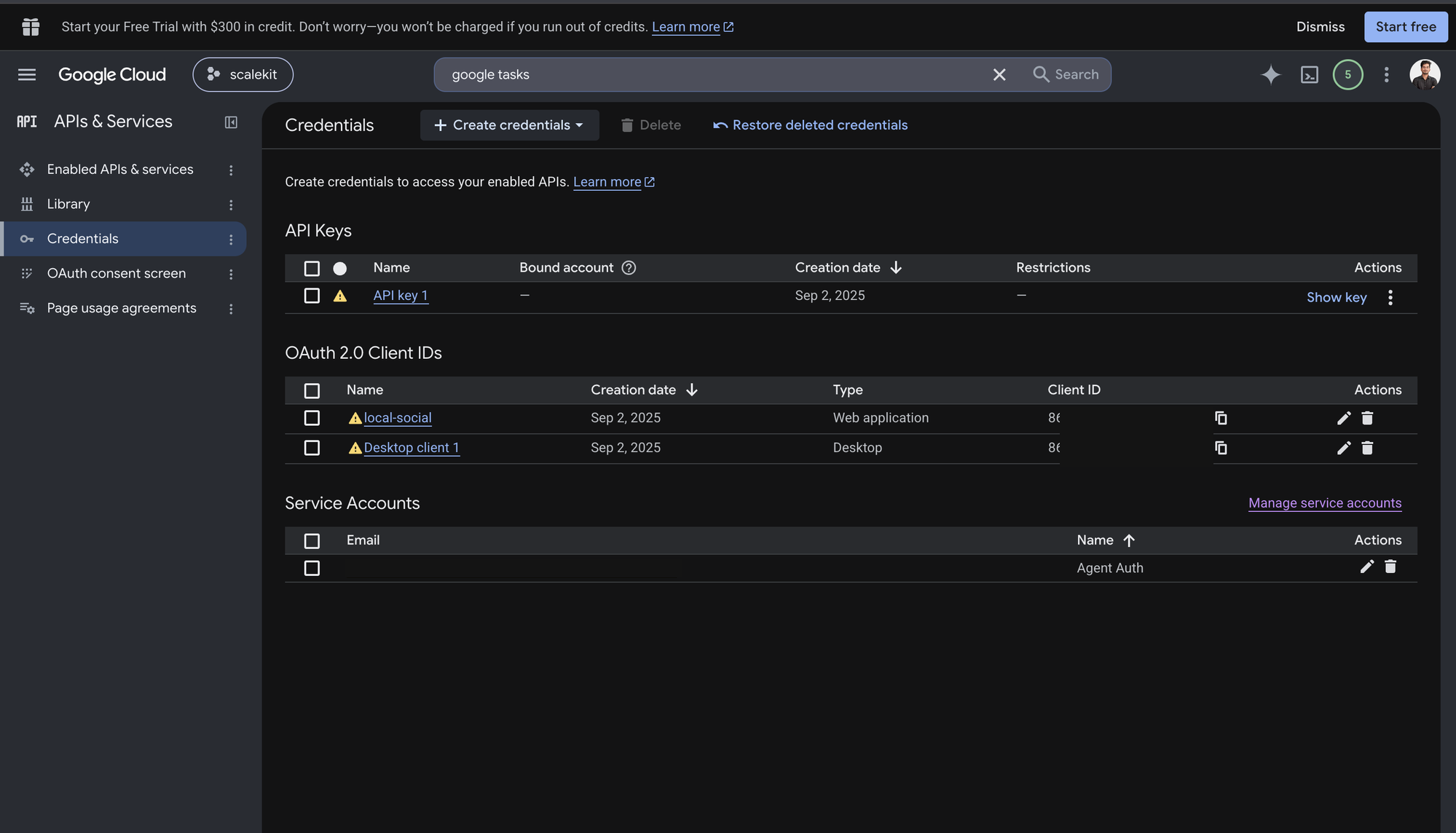
Navigate to Google Cloud Console → APIs & Services → Credentials.
-
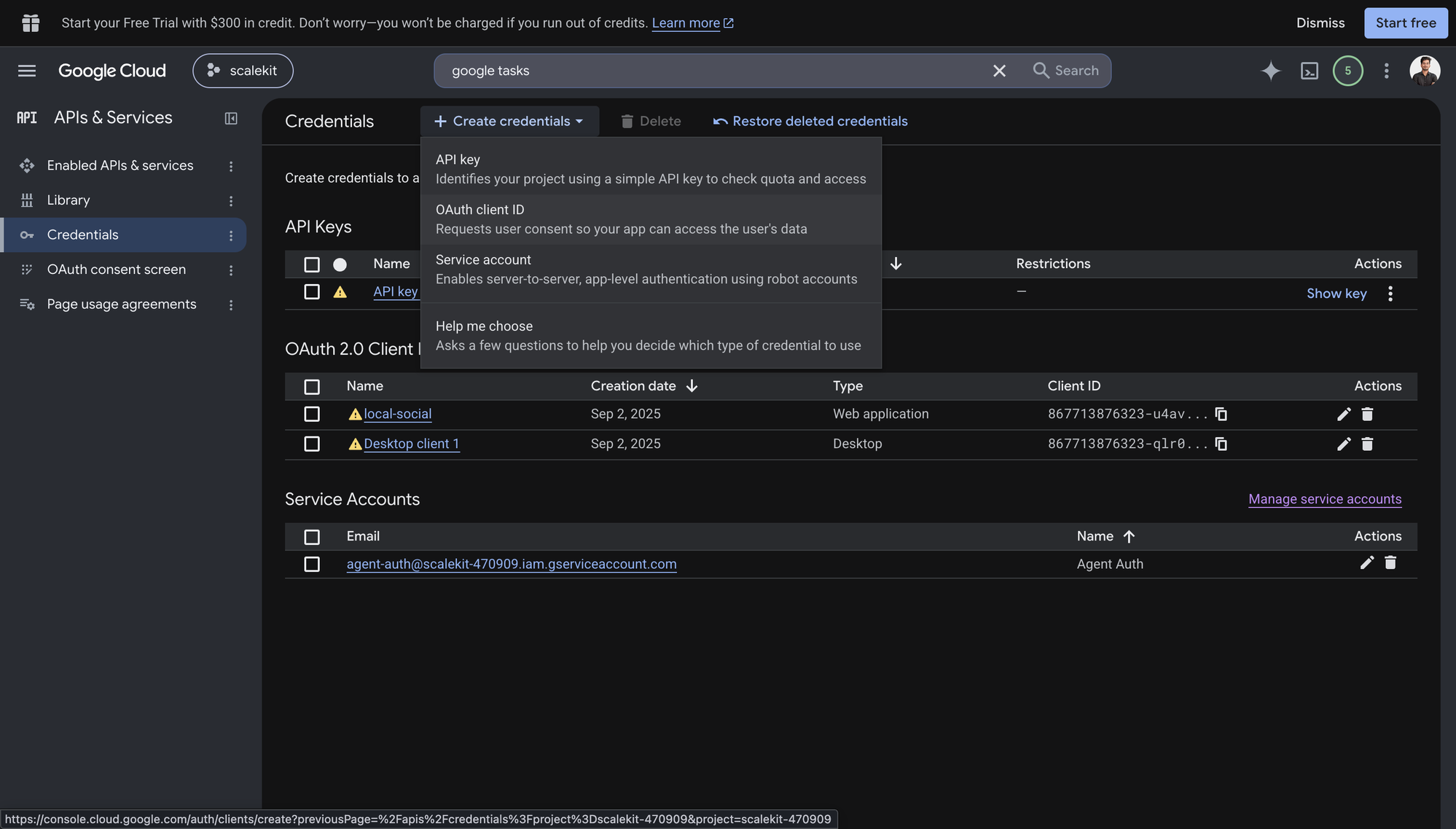
Click + Create Credentials, then OAuth client ID.
-
Choose Web application from the Application type menu and give the client a name, for example
Agent Auth.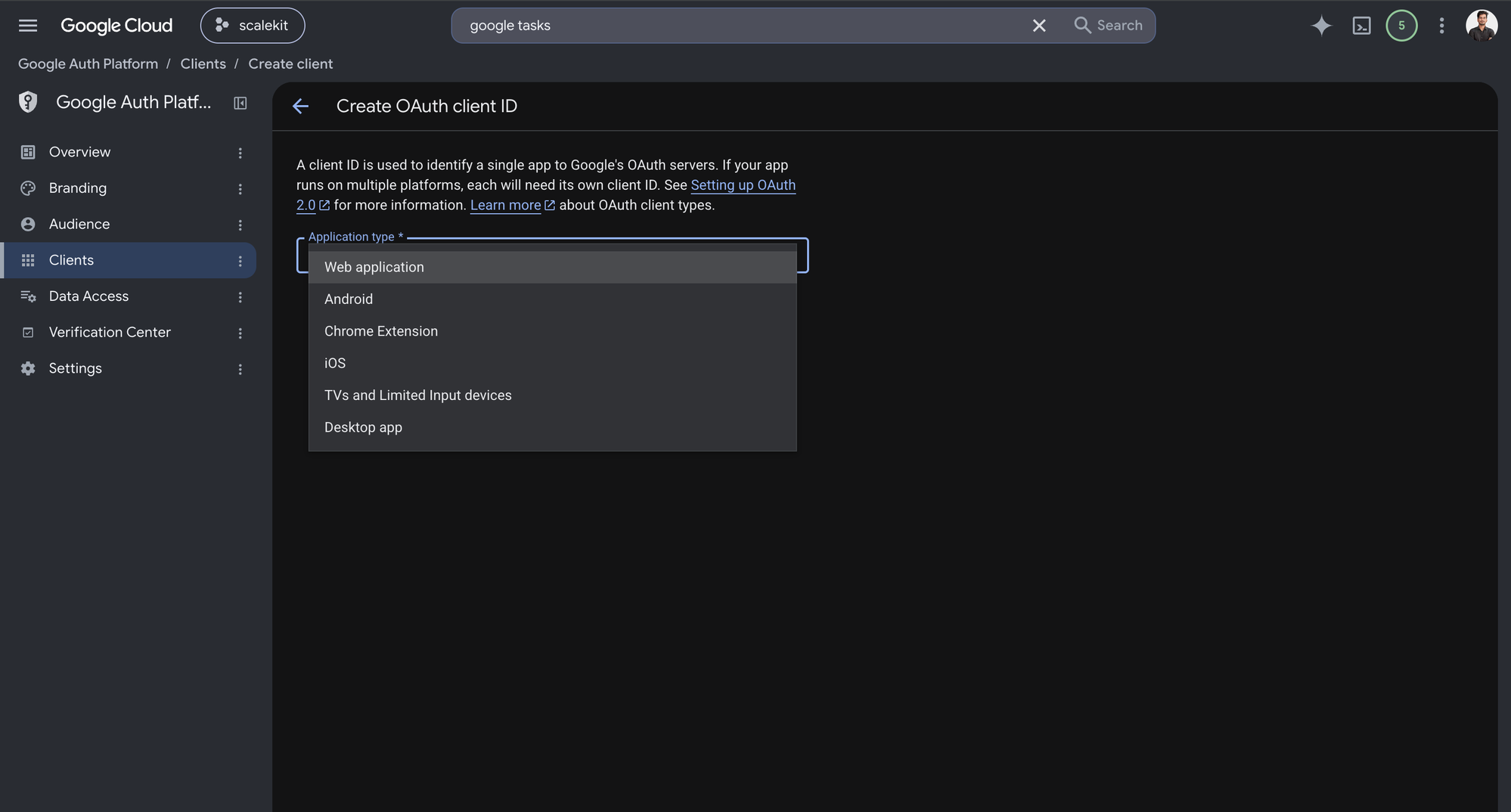
-
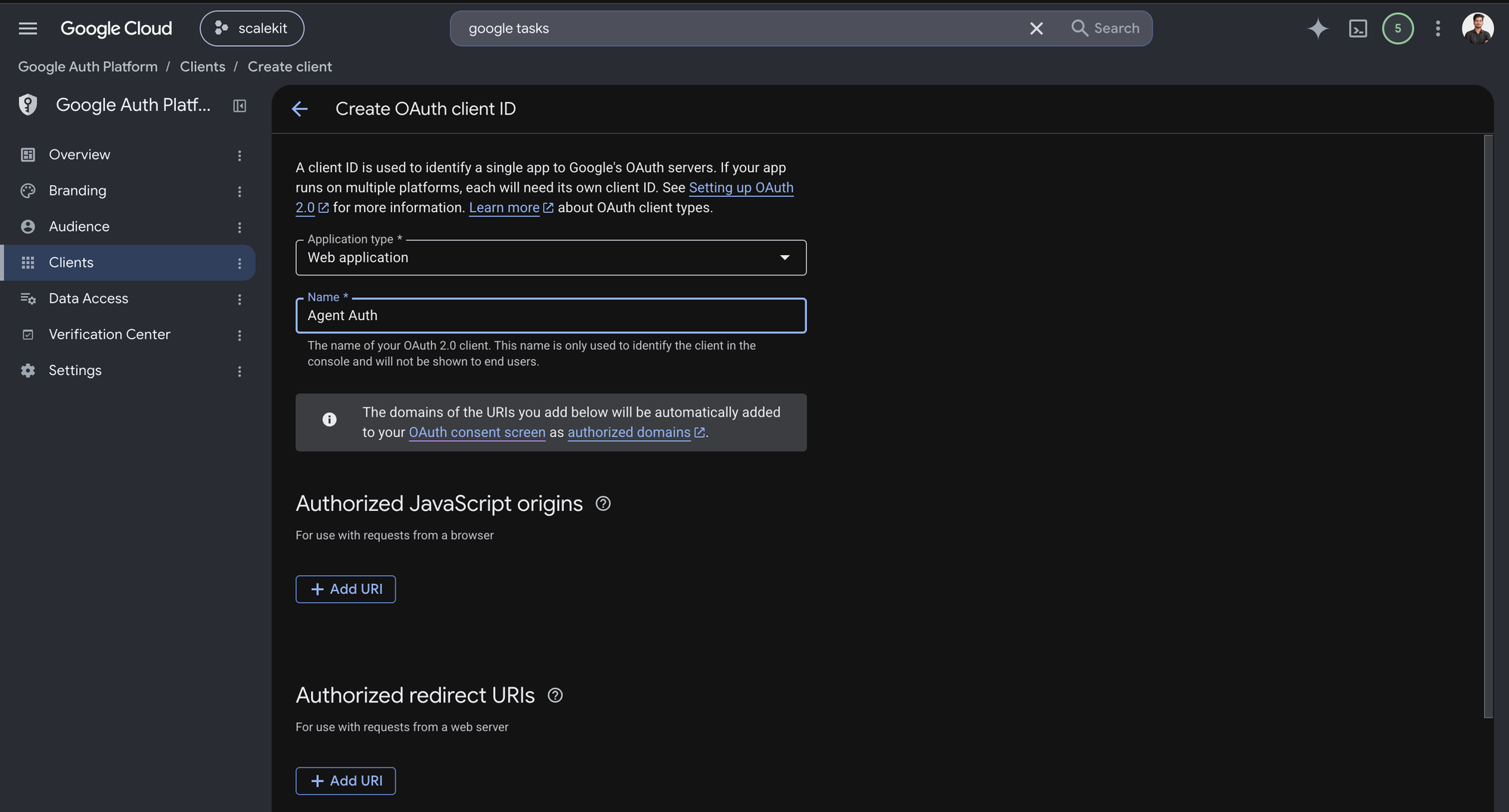
Under Authorized redirect URIs, click + Add URI, paste the redirect URI you copied from Scalekit, and click Create.
-
-
Enable the Google Search Console API
-
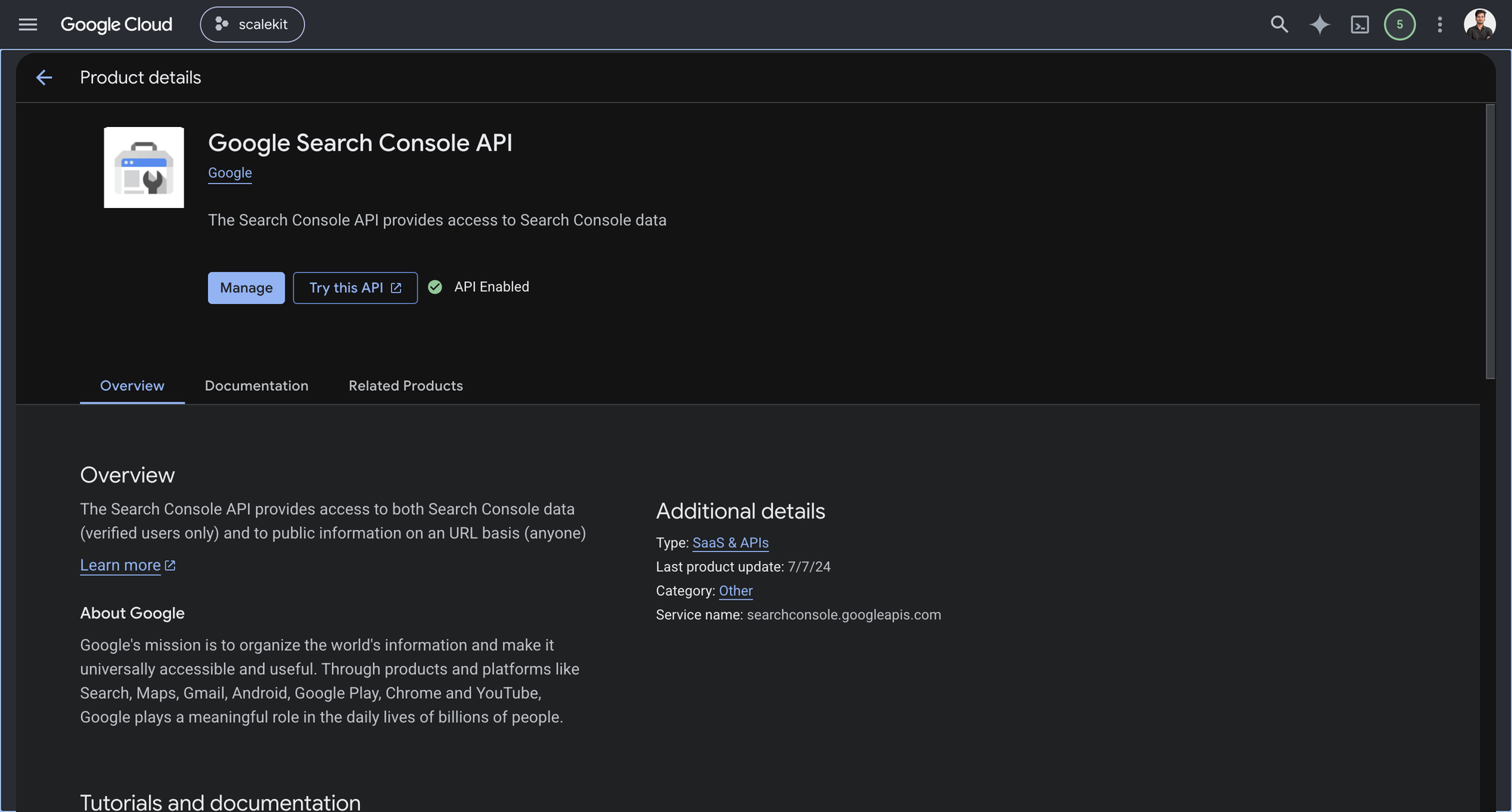
In Google Cloud Console, go to APIs & Services → Library. Search for “Google Search Console API” and click Enable.
-
-
Get client credentials
-
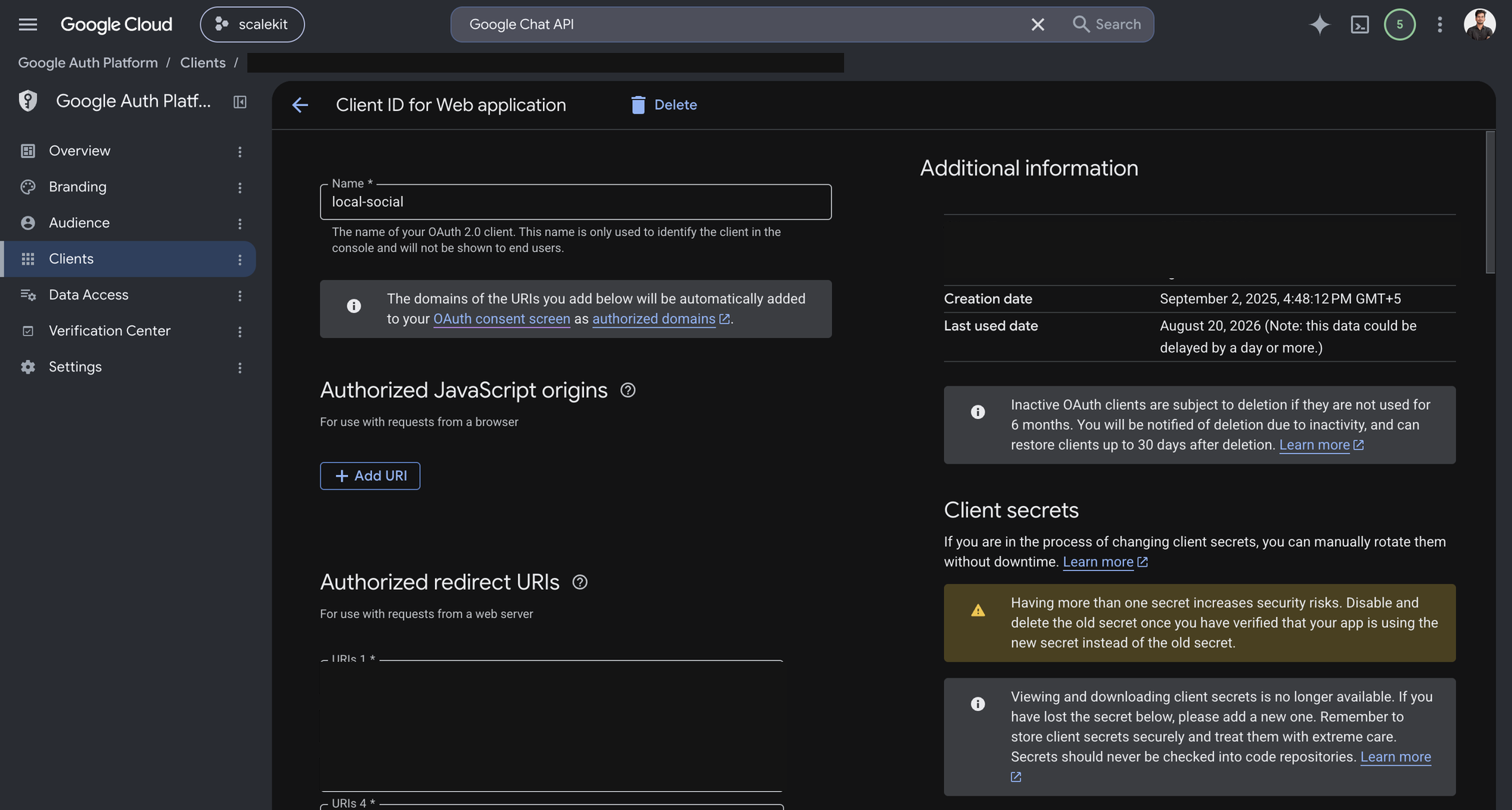
Open the OAuth client you created in step 1. Google shows the Client ID under Additional information, and lets you generate a Client secret from the same page.
-
-
Add credentials in Scalekit
- In Scalekit dashboard, go to AgentKit > Connections and open the connection you created.
- Copy the Connection name shown on that connection and use that exact value in your code as
connection_nameorconnectionName. - Enter your credentials:
- Client ID (from above)
- Client Secret (from above)
- Permissions (scopes — see Google API Scopes reference)
- Click Save.
-
Authorize a user and make your first call
quickstart.mts import { ScalekitClient } from '@scalekit-sdk/node'import 'dotenv/config'import { createInterface } from 'node:readline/promises'const scalekit = new ScalekitClient(process.env.SCALEKIT_ENVIRONMENT_URL,process.env.SCALEKIT_CLIENT_ID,process.env.SCALEKIT_CLIENT_SECRET,)const actions = scalekit.actionsconst connector = 'googlesearchconsole'const identifier = 'user_123'// Generate an authorization link for the userconst { link } = await actions.getAuthorizationLink({ connectionName: connector, identifier })console.log('Authorize Google Search Console:', link)const rl = createInterface({ input: process.stdin, output: process.stdout })await rl.question('Press Enter after authorizing...')rl.close()// Make your first callconst result = await actions.executeTool({connector,identifier,toolName: 'googlesearchconsole_list_sites',toolInput: {},})console.log(result)Terminal window npx tsx quickstart.mtsquickstart.py import osfrom scalekit import ScalekitClientfrom dotenv import load_dotenvload_dotenv()scalekit_client = ScalekitClient(env_url=os.getenv("SCALEKIT_ENVIRONMENT_URL"),client_id=os.getenv("SCALEKIT_CLIENT_ID"),client_secret=os.getenv("SCALEKIT_CLIENT_SECRET"),)actions = scalekit_client.actionsconnection_name = "googlesearchconsole"identifier = "user_123"# Generate an authorization link for the userlink_response = actions.get_authorization_link(connection_name=connection_name,identifier=identifier,)print("Authorize Google Search Console:", link_response.link)input("Press Enter after authorizing...")# Make your first callresult = actions.execute_tool(tool_input={},tool_name="googlesearchconsole_list_sites",connection_name=connection_name,identifier=identifier,)print(result)Terminal window python quickstart.pyEach user signs in once. See Authorize a user for the full flow and statuses.
Tools
Pass the exact name toexecute_toolgooglesearchconsole_get_siteRetrieves the caller's permission level (SITE_OWNER, SITE_FULL_USER, SITE_RESTRICTED_USER, or SITE_UNVERIFIED_USER) for one specific Search Console property.Read-onlyGet Site
Retrieves the caller's permission level (SITE_OWNER, SITE_FULL_USER, SITE_RESTRICTED_USER, or SITE_UNVERIFIED_USER) for one specific Search Console property. Requires the webmasters or webmasters.readonly scope. NOTE: this API requires siteUrl as a single percent-encoded path segment — Scalekit does not auto-encode path values, so you must pass siteUrl already percent-encoded (replace ':' with %3A and every '/' with %2F).
Inputs
siteUrlstringrequired- Required. The percent-encoded URI of the property as defined in Search Console. Get the raw value from the List Sites tool, then percent-encode it: 'https://www.example.com/' becomes 'https%3A%2F%2Fwww.example.com%2F'; 'sc-domain:example.com' becomes 'sc-domain%3Aexample.com'.
googlesearchconsole_get_sitemapRetrieves information about one specific sitemap submitted for a site — its type, whether it is a sitemap index, processing status (pending/downloaded), and error/warning counts.Read-onlyGet Sitemap
Retrieves information about one specific sitemap submitted for a site — its type, whether it is a sitemap index, processing status (pending/downloaded), and error/warning counts. Requires the webmasters or webmasters.readonly scope. NOTE: both siteUrl and feedpath must be single percent-encoded path segments — Scalekit does not auto-encode path values, so pass both already percent-encoded (replace ':' with %3A and every '/' with %2F).
Inputs
feedpathstringrequired- Required. The percent-encoded URL of the sitemap, e.g. 'http://www.example.com/sitemap.xml' percent-encoded to 'http%3A%2F%2Fwww.example.com%2Fsitemap.xml'. Get the raw value from the List Sitemaps tool's `path` field, then percent-encode it the same way as siteUrl.
siteUrlstringrequired- Required. The percent-encoded URI of the property as defined in Search Console. Get the raw value from the List Sites tool, then percent-encode it: 'https://www.example.com/' becomes 'https%3A%2F%2Fwww.example.com%2F'; 'sc-domain:example.com' becomes 'sc-domain%3Aexample.com'.
googlesearchconsole_inspect_urlRuns a Google index inspection for a single URL and reports its Google Search index status — whether and when it was last crawled and indexed, the canonical URL Google selected, mobile-usability/rich-result summary info, and any indexing issues.Read-onlyInspect URL
Runs a Google index inspection for a single URL and reports its Google Search index status — whether and when it was last crawled and indexed, the canonical URL Google selected, mobile-usability/rich-result summary info, and any indexing issues. This is the API equivalent of the URL Inspection tool in the Search Console UI. The inspectionUrl must belong to the property identified by siteUrl. Requires the webmasters or webmasters.readonly scope.
Inputs
inspectionUrlstringrequired- Required. The URL to inspect. Must be under the property specified in siteUrl.
siteUrlstringrequired- Required. The URL of the property as defined in Search Console that owns inspectionUrl. Examples: `https://www.example.com/` for a URL-prefix property, or `sc-domain:example.com` for a Domain property.
languageCodestring- Optional. An IETF BCP-47 language code for translated issue messages, e.g. "en-US" or "de-CH". Defaults to "en-US" if not specified.default
en-US
googlesearchconsole_list_sitemapsLists the sitemap entries submitted for a site, or the entries included in a specific sitemap index file when sitemapIndex is provided.Read-onlyList Sitemaps
Lists the sitemap entries submitted for a site, or the entries included in a specific sitemap index file when sitemapIndex is provided. Returns each sitemap's path, type, processing status, and error/warning counts. Requires the webmasters or webmasters.readonly scope. NOTE: siteUrl must be a single percent-encoded path segment — Scalekit does not auto-encode path values, so pass siteUrl already percent-encoded (replace ':' with %3A and every '/' with %2F). sitemapIndex, in contrast, is a query parameter and should be passed as a normal (non-encoded) URL — Scalekit encodes query values automatically.
Inputs
siteUrlstringrequired- Required. The percent-encoded URI of the property as defined in Search Console. Get the raw value from the List Sites tool, then percent-encode it: 'https://www.example.com/' becomes 'https%3A%2F%2Fwww.example.com%2F'; 'sc-domain:example.com' becomes 'sc-domain%3Aexample.com'.
sitemapIndexstring- Optional. A URL of a site's sitemap index file, e.g. 'http://www.example.com/sitemapindex.xml'. When set, lists the sitemaps contained in that index instead of the site's top-level submitted sitemaps. Pass the plain (not percent-encoded) URL — this is a query parameter and is encoded automatically.
googlesearchconsole_list_sitesLists the user's Search Console sites (properties) along with the caller's permission level for each — SITE_OWNER, SITE_FULL_USER, SITE_RESTRICTED_USER, or SITE_UNVERIFIED_USER.Read-onlyList Sites
Lists the user's Search Console sites (properties) along with the caller's permission level for each — SITE_OWNER, SITE_FULL_USER, SITE_RESTRICTED_USER, or SITE_UNVERIFIED_USER. Use this to discover the exact siteUrl values (e.g. `https://www.example.com/` or `sc-domain:example.com`) needed by every other tool in this connector. Requires the webmasters or webmasters.readonly scope.
Inputs
This tool takes no inputs.
googlesearchconsole_query_search_analyticsQueries Google Search performance data (clicks, impressions, CTR, position) for a site, filtered and grouped by the dimensions you define.Read-onlyQuery Search Analytics
Queries Google Search performance data (clicks, impressions, CTR, position) for a site, filtered and grouped by the dimensions you define. Returns zero or more rows grouped by the row keys you specify via `dimensions`. You must supply a date range (startDate/endDate) of one or more days. When `DATE` is one of the group-by dimensions, days without data are omitted from the results. Requires the webmasters or webmasters.readonly scope. NOTE: siteUrl must be a single percent-encoded path segment — Scalekit does not auto-encode path values, so pass siteUrl already percent-encoded (replace ':' with %3A and every '/' with %2F).
Inputs
endDatestringrequired- Required. End date of the requested date range, in YYYY-MM-DD format, in PST time (UTC-8:00). Must be >= startDate. Inclusive.
siteUrlstringrequired- Required. The percent-encoded URI of the property as defined in Search Console. Get the raw value from the List Sites tool, then percent-encode it: 'https://www.example.com/' becomes 'https%3A%2F%2Fwww.example.com%2F'; 'sc-domain:example.com' becomes 'sc-domain%3Aexample.com'.
startDatestringrequired- Required. Start date of the requested date range, in YYYY-MM-DD format, in PST time (UTC-8:00). Must be <= endDate. Inclusive.
aggregationTypestring- Optional; default AUTO. How data is aggregated — AUTO, BY_PROPERTY, or BY_PAGE (BY_NEWS_SHOWCASE_PANEL for News Showcase reporting). If you filter or group by PAGE, you must use AUTO. An invalid combination returns an API error rather than silently changing your request.
dataStatestring- Optional. The data freshness to include — FINAL (final data only, the default behavior when omitted), ALL (final + partial/fresh data), or HOURLY_ALL (hourly partial + full data; required when dimensions includes HOUR).
dimensionFilterGroupsarray- Optional. Zero or more filter groups to apply to the dimension values, e.g. 'query contains "buy"'. You can filter by a dimension without grouping by it. All filter groups are AND'ed together; filters within a group follow the group's groupType.
dimensionsarray- Optional. Zero or more dimensions to group results by — DATE, QUERY, PAGE, COUNTRY, DEVICE, SEARCH_APPEARANCE, or HOUR (HOUR requires dataState=HOURLY_ALL and data is only available for the last 10 days). Results are grouped in the order supplied.
rowLimitinteger- Optional; default 1000. The maximum number of rows to return. Must be from 1 to 25000 (inclusive).default
1000 startRowinteger- Optional; default 0. Zero-based index of the first row to return, for paging through results beyond rowLimit.default
0 typestring- Optional; default WEB. The Search type to report on — WEB, IMAGE, VIDEO, NEWS, DISCOVER, or GOOGLE_NEWS.
googlesearchconsole_add_siteAdds a site (property) to the set of the authorized user's sites in Search Console.WriteAdd Site
Adds a site (property) to the set of the authorized user's sites in Search Console. The site is added with the caller as owner if verification is already established, otherwise it is added as an unverified site pending verification. Requires the webmasters (full-access) scope. NOTE: this API requires siteUrl as a single percent-encoded path segment — Scalekit does not auto-encode path values, so you must pass siteUrl already percent-encoded (replace ':' with %3A and every '/' with %2F). Returns an empty response on success.
- Idempotent
Inputs
siteUrlstringrequired- Required. The percent-encoded URL of the site to add, e.g. 'https://www.example.com/' percent-encoded to 'https%3A%2F%2Fwww.example.com%2F', or 'sc-domain:example.com' percent-encoded to 'sc-domain%3Aexample.com'.
googlesearchconsole_submit_sitemapSubmits a sitemap for a site so Google will fetch and process it.WriteSubmit Sitemap
Submits a sitemap for a site so Google will fetch and process it. Requires the webmasters (full-access) scope. NOTE: both siteUrl and feedpath must be single percent-encoded path segments — Scalekit does not auto-encode path values, so pass both already percent-encoded (replace ':' with %3A and every '/' with %2F). Returns an empty response on success.
- Idempotent
Inputs
feedpathstringrequired- Required. The percent-encoded URL of the sitemap to submit, e.g. 'http://www.example.com/sitemap.xml' percent-encoded to 'http%3A%2F%2Fwww.example.com%2Fsitemap.xml'.
siteUrlstringrequired- Required. The percent-encoded URI of the property as defined in Search Console. Get the raw value from the List Sites tool, then percent-encode it: 'https://www.example.com/' becomes 'https%3A%2F%2Fwww.example.com%2F'; 'sc-domain:example.com' becomes 'sc-domain%3Aexample.com'.
googlesearchconsole_delete_siteRemoves a site (property) from the set of the authorized user's Search Console sites.DestructiveDelete Site
Removes a site (property) from the set of the authorized user's Search Console sites. This only removes the site from this user's Search Console account — it does NOT affect the site itself, its verification status for other users, or Google's crawling/indexing of it. Requires the webmasters (full-access) scope. NOTE: this API requires siteUrl as a single percent-encoded path segment — Scalekit does not auto-encode path values, so you must pass siteUrl already percent-encoded (replace ':' with %3A and every '/' with %2F). Returns an empty response on success.
- Idempotent
Inputs
siteUrlstringrequired- Required. The percent-encoded URI of the property to remove, as defined in Search Console. Get the raw value from the List Sites tool, then percent-encode it: 'https://www.example.com/' becomes 'https%3A%2F%2Fwww.example.com%2F'; 'sc-domain:example.com' becomes 'sc-domain%3Aexample.com'.
googlesearchconsole_delete_sitemapRemoves a sitemap from the Sitemaps report for a site.DestructiveDelete Sitemap
Removes a sitemap from the Sitemaps report for a site. This does NOT stop Google from crawling the sitemap or the URLs that were previously discovered through it — it only removes the sitemap entry from Search Console's report. Requires the webmasters (full-access) scope. NOTE: both siteUrl and feedpath must be single percent-encoded path segments — Scalekit does not auto-encode path values, so pass both already percent-encoded (replace ':' with %3A and every '/' with %2F). Returns an empty response on success.
- Idempotent
Inputs
feedpathstringrequired- Required. The percent-encoded URL of the sitemap to remove, e.g. 'http://www.example.com/sitemap.xml' percent-encoded to 'http%3A%2F%2Fwww.example.com%2Fsitemap.xml'. Get the raw value from the List Sitemaps tool's `path` field, then percent-encode it the same way as siteUrl.
siteUrlstringrequired- Required. The percent-encoded URI of the property as defined in Search Console. Get the raw value from the List Sites tool, then percent-encode it: 'https://www.example.com/' becomes 'https%3A%2F%2Fwww.example.com%2F'; 'sc-domain:example.com' becomes 'sc-domain%3Aexample.com'.
No tools match.