

Sync B2B billing with Scalekit and Chargebee
Map Scalekit organizations to Chargebee customers, run hosted checkout, and keep subscription state in sync via webhooks.
Multi-tenant B2B SaaS apps authenticate users through Scalekit organizations, but bill through Chargebee subscriptions. Those two systems do not share a database. Without an explicit mapping, you end up with duplicate Chargebee customers, subscriptions that never activate after checkout, or feature gates that read stale plan data.
This cookbook wires Scalekit organizations and sessions to Chargebee using org-mode billing: the organization ID from the access token (oid) becomes the billing referenceId, Scalekit webhooks provision Chargebee customers, and Chargebee webhooks keep your local subscription table current. You own the routes, schema, and authorization that connect the two systems.
What you get
Section titled “What you get”- Chargebee customers created when Scalekit fires
organization.created(not on every user signup) - Local org ↔ Chargebee customer mapping keyed by the Scalekit organization ID
- Hosted checkout and customer portal via Chargebee hosted pages
- Local subscription cache driven by Chargebee webhooks, plus optional eager sync on checkout redirect
- Session-scoped authorization so billing APIs only act on the caller’s org (
referenceId === oid) - Lifecycle hooks for product logic (after customer create, subscription complete/cancel, authorize deny)
Who needs this
Section titled “Who needs this”This cookbook is for you if:
- ✅ You authenticate with Scalekit and use organizations (
oidin access tokens) - ✅ You bill per organization, not per individual user
- ✅ You use Chargebee hosted checkout or the customer portal
- ✅ You maintain a local subscription cache to gate features in your app
You don’t need this if:
- ❌ You bill per user, not per organization
- ❌ Scalekit manages your entire product catalog and entitlements (no separate billing system)
How the integration fits together
Section titled “How the integration fits together”Treat the Scalekit organization ID as the single billing reference for the tenant. Scalekit authenticates the user and org, your app owns the mapping and local subscription cache, and Chargebee owns catalog, checkout, and billing state.
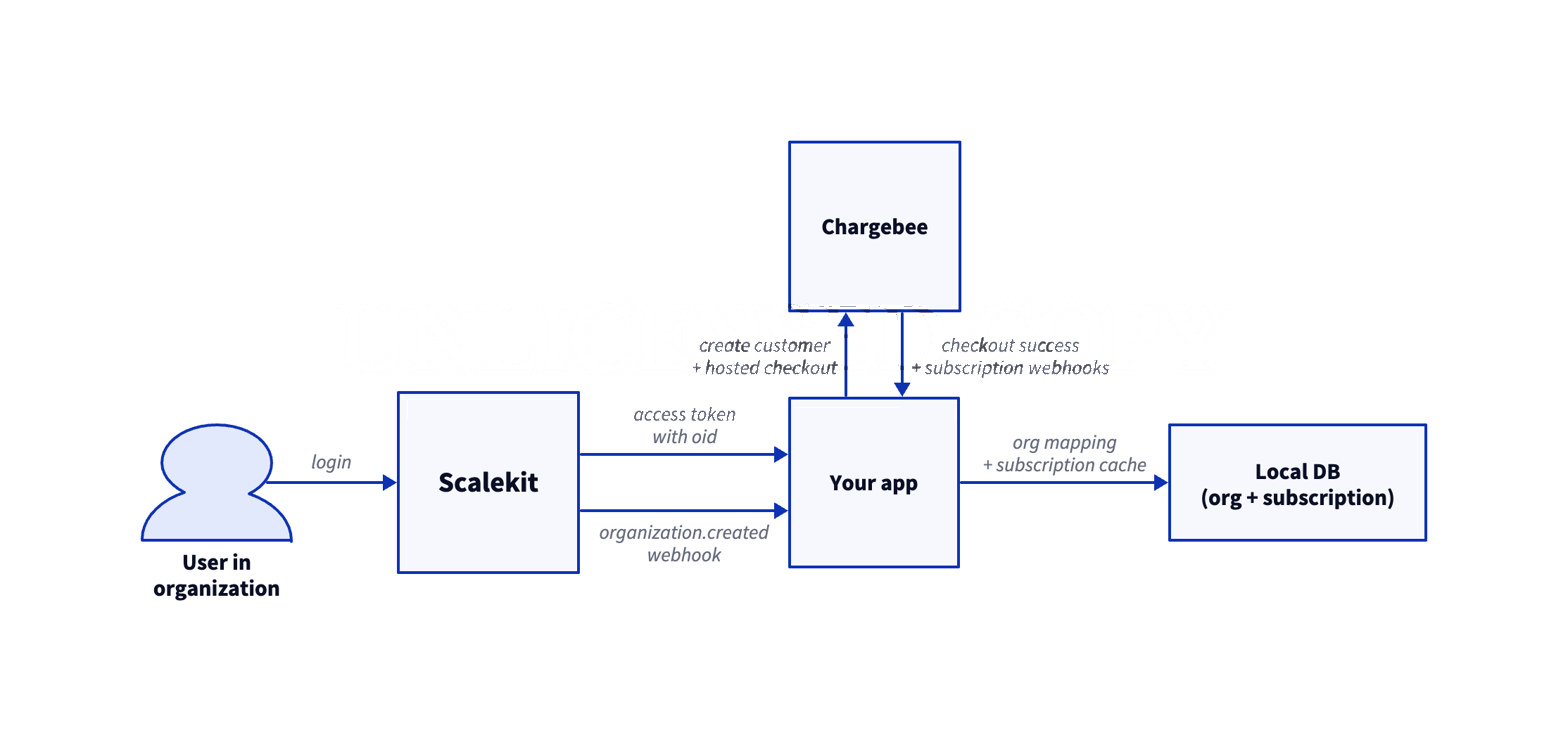
The integration has four seams:
- Provision on org create — Scalekit
organization.createdwebhook → create a Chargebee customer and store the mapping locally. - Authorize every billing call — session
oidmust match the billingreferenceIdbefore any Chargebee API call. - Future subscription before checkout — create a local row with
status: future, stamppendingSubscriptionIdon Chargebee customer metadata, then redirect to hosted checkout. - Reconcile from Chargebee — subscription webhooks (and an eager sync on checkout redirect) update the local row to
active,in_trial, or cancelled.
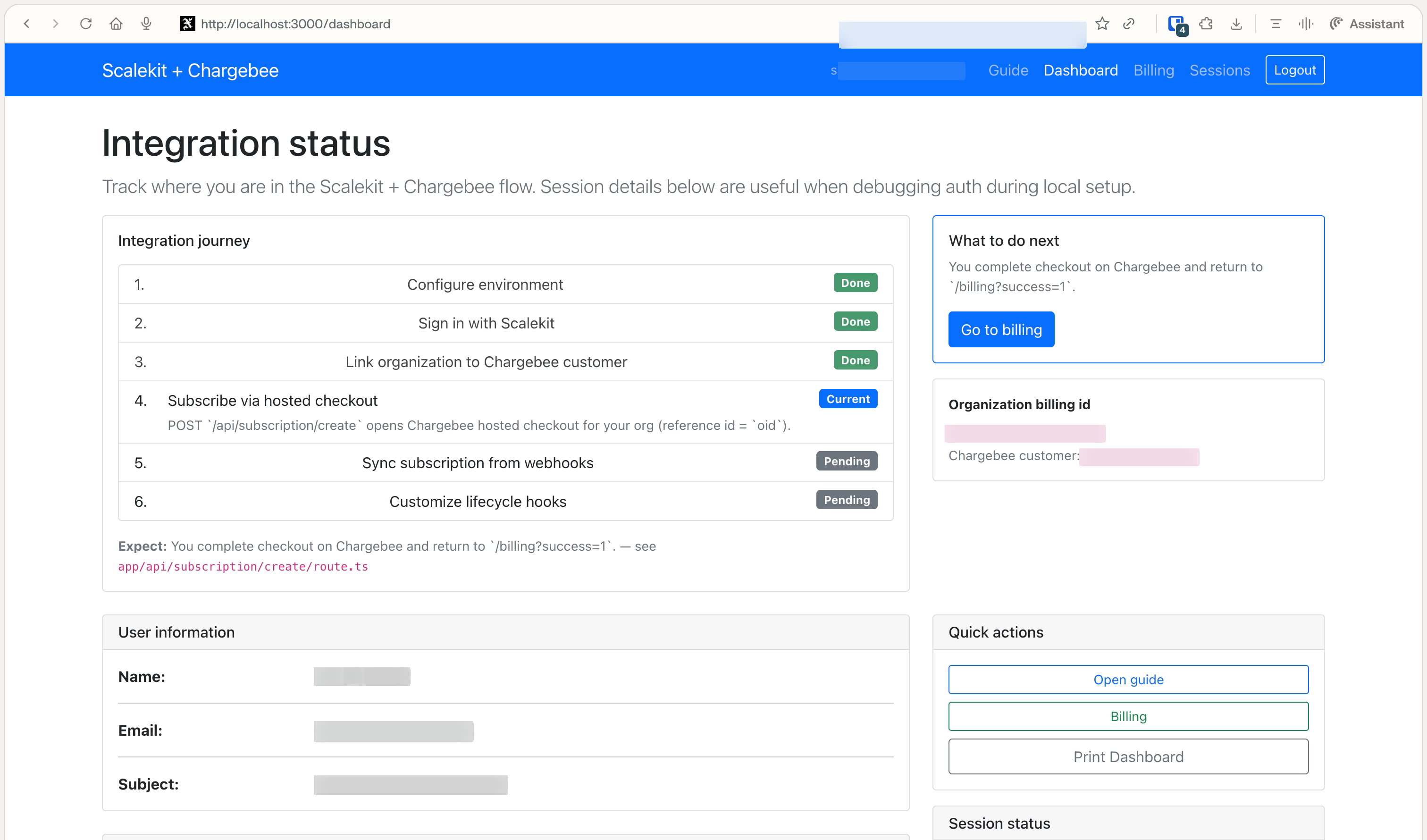
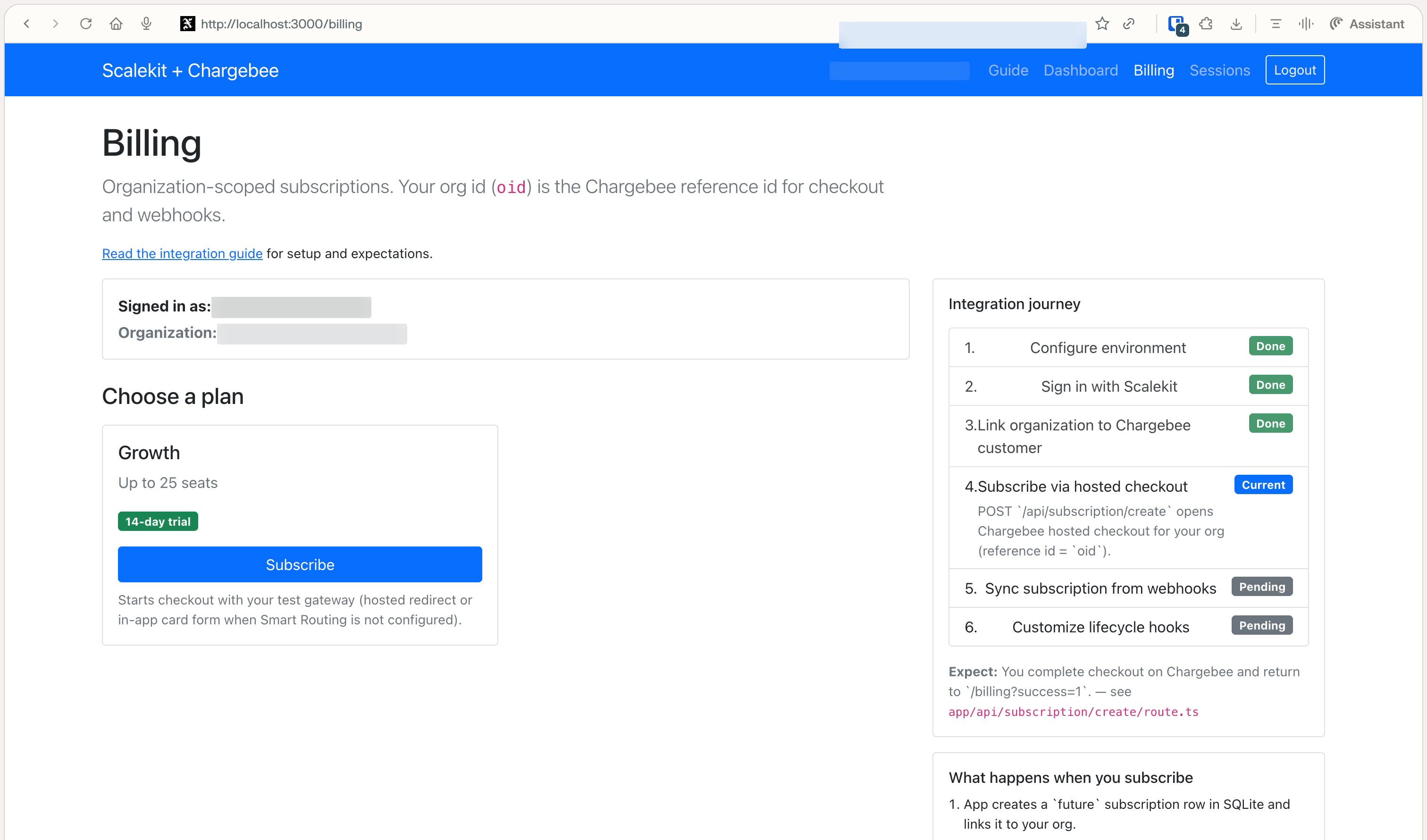
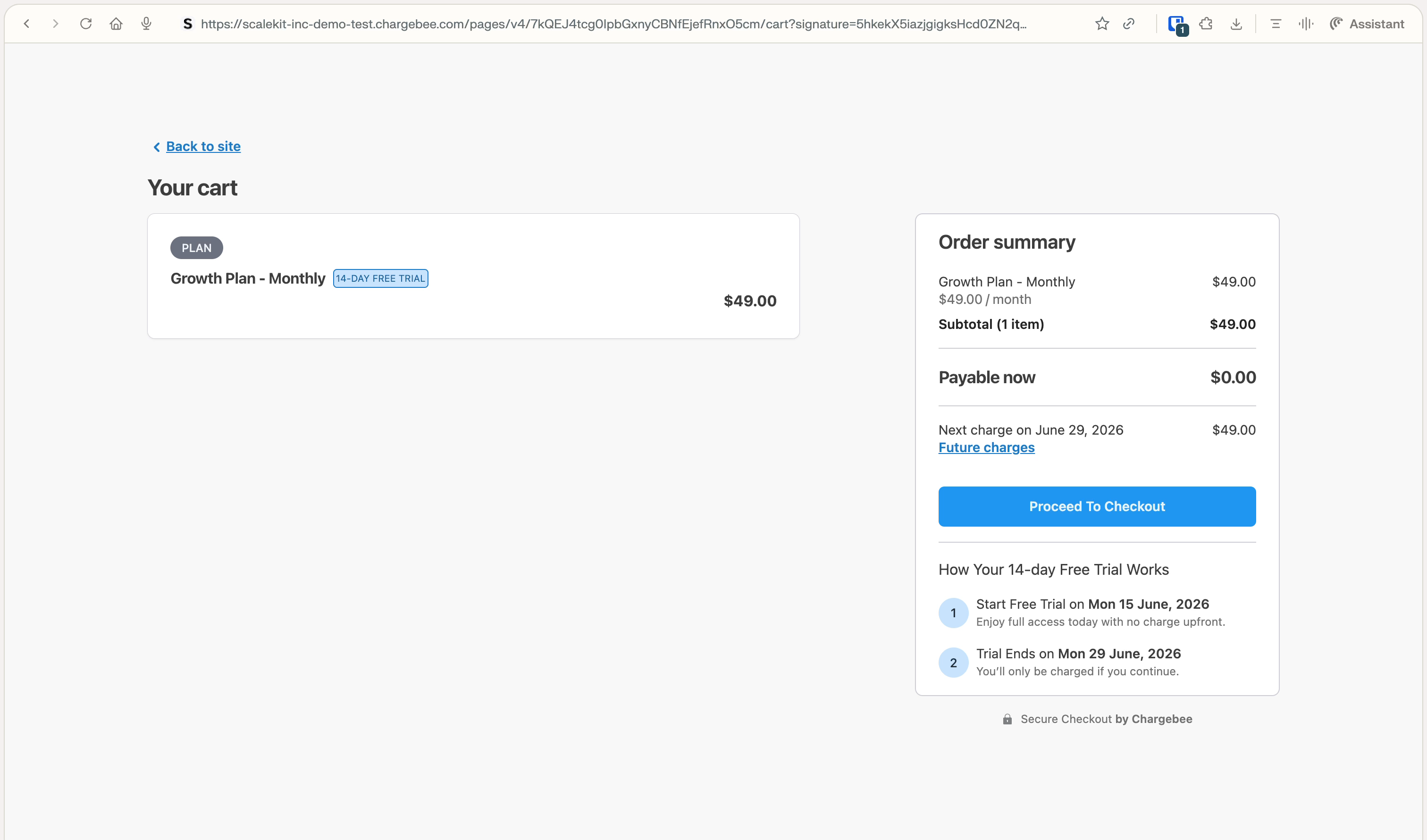
Screenshots below are from the reference demo so you can match each milestone to the product UI.
Before you start
Section titled “Before you start”| Prerequisite | Where to get it |
|---|---|
| Scalekit environment with organizations | Scalekit dashboard |
OAuth client (skc_...) + redirect URI | API Keys in the dashboard |
| Chargebee sandbox site (Product Catalog 2.0) | Chargebee test site |
Plan item price ID (for example growth-plan-monthly) | Chargebee Product Catalog — reference prices by ID in code |
Test payment gateway (gw_...) | Chargebee Payment Gateways |
| Public tunnel for webhooks | ngrok, LocalTunnel, or similar |
Step 1: Install packages
Section titled “Step 1: Install packages”Install the Scalekit and Chargebee SDKs on the server (API routes, webhook handlers). Use whichever package manager you use in your app (npm, pnpm, or yarn); the example below matches the reference app:
npm install @scalekit-sdk/node chargebeeSnippets in this cookbook are Node.js / Next.js App Router, aligned with the reference app. Scalekit client concepts (token validation, webhook verification, oid) apply across SDKs; adapt routes and session storage if you run another stack. Chargebee’s primary SDK surface used here is the Node package.
Use your ORM of choice for the local billing tables (the reference app uses Drizzle + SQLite). Keep Chargebee secret API keys server-side only; publishable keys for Chargebee.js may use NEXT_PUBLIC_* if you embed payment components.
Step 2: Configure environment variables
Section titled “Step 2: Configure environment variables”Define these in your server environment (for example .env locally and your host’s secrets store in production).
| Variable | Purpose |
|---|---|
SCALEKIT_ENVIRONMENT_URL | Scalekit environment URL |
SCALEKIT_CLIENT_ID / SCALEKIT_CLIENT_SECRET | OAuth client |
SCALEKIT_REDIRECT_URI | OAuth callback (for example http://localhost:3000/auth/callback) |
SCALEKIT_WEBHOOK_SECRET | Verify Scalekit webhook signatures |
CHARGEBEE_SITE | Chargebee site subdomain |
CHARGEBEE_API_KEY | Full-access API key for your Chargebee site |
CHARGEBEE_PLAN_ITEM_PRICE_ID | Default plan item price ID from Product Catalog 2.0 |
CHARGEBEE_GATEWAY_ACCOUNT_ID | Optional gateway pin for hosted checkout (gw_...) |
CHARGEBEE_WEBHOOK_USERNAME / CHARGEBEE_WEBHOOK_PASSWORD | Basic Auth for Chargebee webhooks (recommended in production) |
NEXT_PUBLIC_APP_URL | App base URL for hosted-page redirects |
SCALEKIT_ENVIRONMENT_URL=https://your-env.scalekit.devSCALEKIT_CLIENT_ID=skc_...SCALEKIT_CLIENT_SECRET=SCALEKIT_REDIRECT_URI=http://localhost:3000/auth/callbackSCALEKIT_WEBHOOK_SECRET=CHARGEBEE_SITE=your-site-testCHARGEBEE_API_KEY=CHARGEBEE_PLAN_ITEM_PRICE_ID=growth-plan-monthlyCHARGEBEE_GATEWAY_ACCOUNT_ID=gw_your_test_gateway_idCHARGEBEE_WEBHOOK_USERNAME=CHARGEBEE_WEBHOOK_PASSWORD=NEXT_PUBLIC_APP_URL=http://localhost:3000Step 3: Add local schema
Section titled “Step 3: Add local schema”Add tables for organizations, subscriptions, and optional line items. The organization row holds the Chargebee customer ID; subscriptions are keyed by reference_id (the Scalekit org ID from oid). Default new subscriptions to future so checkout can reconcile before Chargebee assigns a subscription ID.
CREATE TABLE organization ( id TEXT PRIMARY KEY, display_name TEXT, chargebee_customer_id TEXT UNIQUE, updated_at INTEGER);
CREATE TABLE subscription ( id TEXT PRIMARY KEY, reference_id TEXT NOT NULL, chargebee_customer_id TEXT, chargebee_subscription_id TEXT UNIQUE, status TEXT NOT NULL DEFAULT 'future', period_start INTEGER, period_end INTEGER, trial_start INTEGER, trial_end INTEGER, canceled_at INTEGER, seats INTEGER, metadata TEXT);
CREATE TABLE subscription_item ( id TEXT PRIMARY KEY, subscription_id TEXT NOT NULL REFERENCES subscription(id) ON DELETE CASCADE, item_price_id TEXT NOT NULL, item_type TEXT NOT NULL, quantity INTEGER NOT NULL, unit_price INTEGER, amount INTEGER);Translate to your ORM. Index reference_id — webhook handlers and list endpoints query by org ID on every request.
After this step: migrations applied; empty tables ready for provisioning and checkout.
Step 4: Initialize clients
Section titled “Step 4: Initialize clients”Create lazy singletons from environment variables. Never hardcode API keys.
import { ScalekitClient } from '@scalekit-sdk/node';
let scalekitClient: ScalekitClient | null = null;
export function getScalekitClient(): ScalekitClient { if (!scalekitClient) { const envUrl = process.env.SCALEKIT_ENVIRONMENT_URL; const clientId = process.env.SCALEKIT_CLIENT_ID; const clientSecret = process.env.SCALEKIT_CLIENT_SECRET; if (!envUrl || !clientId || !clientSecret) { throw new Error( 'Set SCALEKIT_ENVIRONMENT_URL, SCALEKIT_CLIENT_ID, and SCALEKIT_CLIENT_SECRET.' ); } scalekitClient = new ScalekitClient(envUrl, clientId, clientSecret); } return scalekitClient;}import Chargebee from 'chargebee';
let chargebeeClient: Chargebee | null = null;
export function getChargebeeClient(): Chargebee { if (!chargebeeClient) { const site = process.env.CHARGEBEE_SITE; const apiKey = process.env.CHARGEBEE_API_KEY; if (!site || !apiKey) { throw new Error('Set CHARGEBEE_SITE and CHARGEBEE_API_KEY.'); } chargebeeClient = new Chargebee({ site, apiKey }); } return chargebeeClient;}Step 5: Provision Chargebee customers from Scalekit webhooks
Section titled “Step 5: Provision Chargebee customers from Scalekit webhooks”Register a Scalekit webhook for organization.created, organization.updated, and organization.deleted. Point it at your public URL (use a tunnel in local dev):
https://your-domain.com/api/webhooks/scalekitVerify the signature on the raw request body before parsing JSON.
import { NextRequest, NextResponse } from 'next/server';import { getScalekitClient } from '@/lib/scalekit';import { createOrgCustomer } from '@/lib/billing/create-org-customer';import { cleanupOrganizationBilling } from '@/lib/billing/cleanup-org';import { upsertOrganization } from '@/lib/db/organizations';
export async function POST(req: NextRequest) { const rawBody = await req.text(); const secret = process.env.SCALEKIT_WEBHOOK_SECRET; if (!secret) { return NextResponse.json({ error: 'Webhook secret not configured' }, { status: 500 }); }
const headers: Record<string, string> = {}; req.headers.forEach((value, key) => { headers[key.toLowerCase()] = value; });
const client = getScalekitClient(); const isValid = client.verifyWebhookPayload(secret, headers, rawBody); if (!isValid) { return NextResponse.json({ error: 'Invalid signature' }, { status: 401 }); }
const event = JSON.parse(rawBody); const organizationId = event.organization_id ?? event.data?.id;
if (event.type === 'organization.created' && organizationId) { await createOrgCustomer({ organizationId, displayName: event.data?.display_name ?? null, }); } else if (event.type === 'organization.updated' && organizationId) { await upsertOrganization({ id: organizationId, displayName: event.data?.display_name ?? null, }); } else if (event.type === 'organization.deleted' && organizationId) { await cleanupOrganizationBilling(organizationId); }
return NextResponse.json({ received: true });}createOrgCustomer upserts the local organization row, creates a Chargebee customer if one does not exist, and stores organizationId in Chargebee meta_data. Make it idempotent: check the local mapping before calling customer.create, and handle races if checkout runs before the webhook finishes.
const { customer } = await chargebee.customer.create({  company: displayName ?? undefined,  email: email ?? undefined,  preferred_currency_code: 'USD',  meta_data: {    organizationId,    customerType: 'organization',  },});
await setChargebeeCustomerId(organizationId, customer.id);
Return 2xx after accepting the event. Scalekit retries on non-2xx responses. The reference app enqueues work with setImmediate so the HTTP response is fast; either pattern works if handlers are idempotent.
After this step: create an organization in Scalekit → local organization row and a Chargebee customer with matching organizationId metadata appear.
In the reference app dashboard, steps 1–3 show Done and the org is linked to a Chargebee customer before you open billing:
Step 6: Read the organization ID from the session
Section titled “Step 6: Read the organization ID from the session”Billing routes need org context from the access token. Validate the token on every request and require the oid claim. Do not call /userinfo for billing context.
import { decodeJwt } from 'jose';
const isValid = await scalekit.validateAccessToken(accessToken);if (!isValid) { throw new SessionError(401, 'Invalid or expired token');}
// Safe after validateAccessToken: signature and standard claims already checked.const claims = decodeJwt(accessToken);
const organizationId = claims.oid as string | undefined;if (!organizationId) { throw new SessionError(403, 'Organization context required for billing');}
return { userId: claims.sub as string, email: claims.email as string, organizationId,};Step 7: Authorize billing references
Section titled “Step 7: Authorize billing references”Before any Chargebee API call, confirm the caller’s session org matches the billing reference. Extend with a product hook to deny delinquent orgs without changing Chargebee configuration.
export type AuthorizeReferenceAction = | 'create' | 'update' | 'cancel' | 'portal' | 'list';
export async function authorizeReference({ userId, organizationId, referenceId, action,}: { userId: string; organizationId: string; referenceId: string; action: AuthorizeReferenceAction;}): Promise<boolean> { if (referenceId !== organizationId) { return false; } // Optional: return false from onAuthorizeReference to deny specific orgs. return onAuthorizeReference({ userId, organizationId, referenceId, action }) !== false;}After this step: a request with referenceId that does not match session oid returns 403 before Chargebee is called.
Step 8: Start hosted checkout with a future subscription
Section titled “Step 8: Start hosted checkout with a future subscription”When an org admin clicks Subscribe, create a local future row first, stamp pending IDs on the Chargebee customer, then call hostedPage.checkoutNewForItems. Use item price IDs from your Chargebee product catalog.
const ctx = await requireSession();const referenceId = body.referenceId ?? ctx.organizationId;
if ( !(await authorizeReference({ userId: ctx.userId, organizationId: ctx.organizationId, referenceId, action: 'create', }))) { return NextResponse.json({ error: 'Forbidden' }, { status: 403 });}
const active = await findActiveByReferenceId(referenceId);if (active) { return NextResponse.json( { error: 'An active subscription already exists for this organization' }, { status: 400 } );}
const customerId = await getOrCreateCustomerId({ organizationId: referenceId, email: ctx.email,});
const localSub = await createFutureSubscription({ referenceId, chargebeeCustomerId: customerId,});
await chargebee.customer.update(customerId, { meta_data: { pendingSubscriptionId: localSub.id, pendingReferenceId: referenceId, organizationId: referenceId, userId: ctx.userId, },});
const result = await chargebee.hostedPage.checkoutNewForItems({ subscription_items: [{ item_price_id: planItemPriceId, quantity: seats }], customer: { id: customerId }, redirect_url: successRedirect, // includes local subscriptionId for eager sync cancel_url: absoluteUrl(cancelUrl), // Optional: pin gateway when Smart Routing cannot auto-select // ...getHostedCheckoutCardOptions(),});
return NextResponse.json({ mode: 'hosted', url: result.hosted_page.url });The future row gives your app a stable ID to reconcile against before Chargebee assigns a subscription ID. Reject create when an active subscription already exists for the org.
After this step: POST /api/subscription/create returns { mode: 'hosted', url }; completing checkout in the sandbox creates or updates the Chargebee subscription.
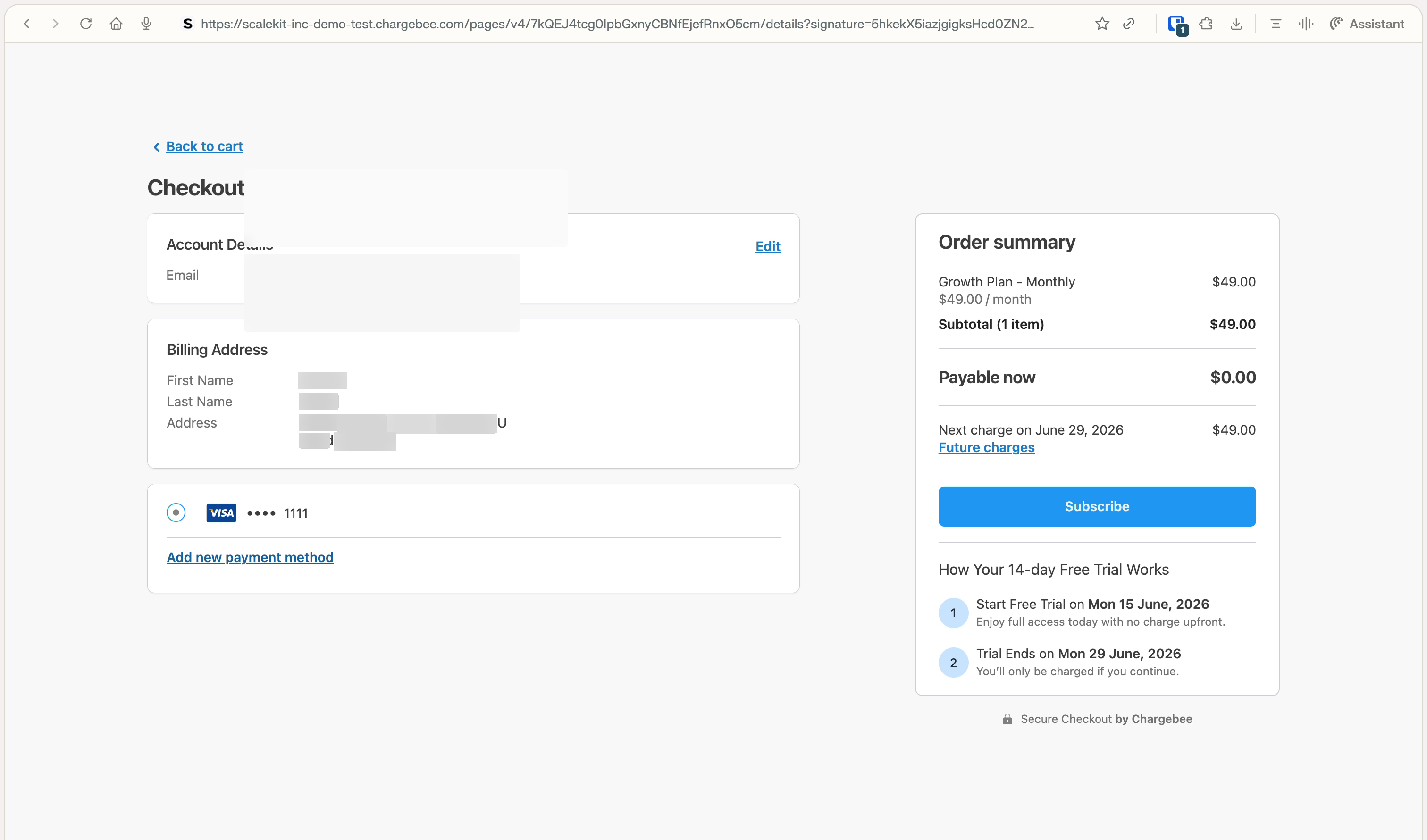
In the demo, the billing page lists plans scoped to the session org. Subscribe calls your create route, then redirects to Chargebee hosted pages:
Step 9: Configure Chargebee webhooks
Section titled “Step 9: Configure Chargebee webhooks”In the Chargebee dashboard, create a webhook endpoint that points to:
https://your-domain.com/api/webhooks/chargebeeProtect the route with HTTP Basic Auth using CHARGEBEE_WEBHOOK_USERNAME and CHARGEBEE_WEBHOOK_PASSWORD. Enter the same credentials under Basic Authentication in the Chargebee webhook settings.
Subscribe at least to these events (names as in Chargebee / the Node SDK):
| Chargebee event | Action |
|---|---|
subscription_created | Link chargebee_subscription_id, set status |
subscription_activated / subscription_started | Mark active or in_trial, run entitlements hooks |
subscription_changed / subscription_renewed | Update plan, seats, period dates |
subscription_cancelled | Mark cancelled, revoke entitlements |
customer_deleted | Clear local customer mapping |
Lookup order when matching a webhook to a local row:
chargebee_subscription_idon the local row- Subscription metadata (if you stamp IDs on the Chargebee subscription)
meta_data.pendingSubscriptionIdon the Chargebee customerfuturerow byreference_id
import { NextRequest, NextResponse } from 'next/server';import { WebhookAuthenticationError, basicAuthValidator,} from 'chargebee';import { processChargebeeWebhookEvent } from '@/lib/billing/chargebee-webhook-handler';
export async function POST(req: NextRequest) { const username = process.env.CHARGEBEE_WEBHOOK_USERNAME; const password = process.env.CHARGEBEE_WEBHOOK_PASSWORD;
const headers: Record<string, string | string[] | undefined> = {}; req.headers.forEach((value, key) => { headers[key.toLowerCase()] = value; });
if (username && password) { try { await basicAuthValidator( (user, pass) => user === username && pass === password )(headers); } catch (err) { if (err instanceof WebhookAuthenticationError) { return NextResponse.json({ error: 'Unauthorized' }, { status: 401 }); } return NextResponse.json({ error: 'Unauthorized' }, { status: 401 }); } }
const event = await req.json(); await processChargebeeWebhookEvent(event); return NextResponse.json({ received: true });}After this step: cancel or change a plan in Chargebee → local subscription status updates without a page refresh loop.
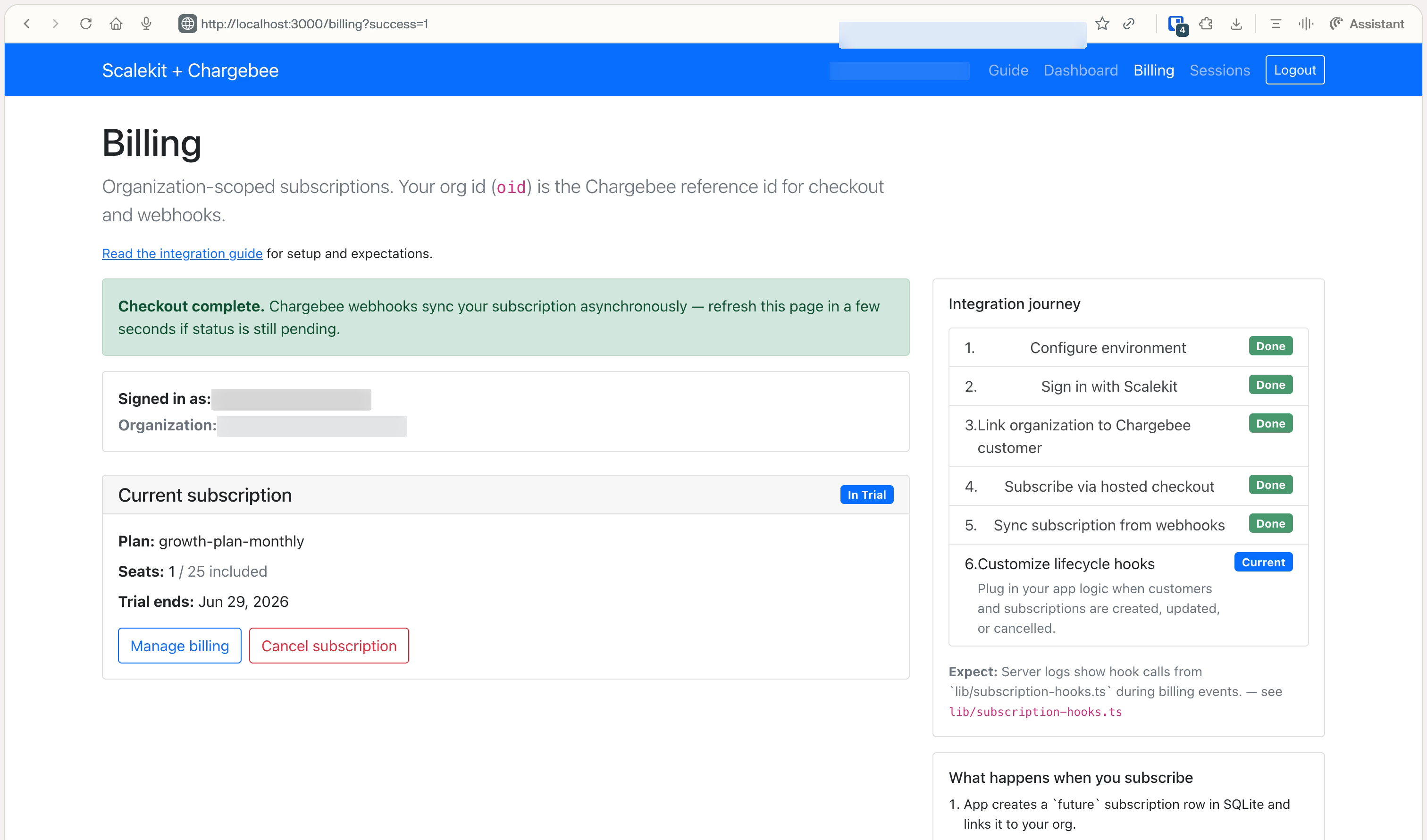
After a successful checkout (and webhook or eager sync), the billing UI shows the live plan status — for example In Trial — and the journey marks subscribe and webhook sync as Done:
Step 10: Eager-sync on checkout redirect
Section titled “Step 10: Eager-sync on checkout redirect”Hosted checkout redirects to your success URL before webhooks arrive. Add an eager sync so the billing page shows the subscription immediately. Webhooks remain the source of truth for ongoing changes.
export async function GET(request: NextRequest) { const subscriptionId = request.nextUrl.searchParams.get('subscriptionId'); const callbackURL = request.nextUrl.searchParams.get('callbackURL') ?? '/billing?success=1';
if (subscriptionId) { const local = await findSubscriptionById(subscriptionId); if (local?.chargebeeSubscriptionId) { const result = await chargebee.subscription.retrieve( local.chargebeeSubscriptionId ); await syncLocalFromChargebeeSubscription(local, result.subscription); } else if (local?.chargebeeCustomerId) { // Fallback: list recent subscriptions for the customer and sync the latest const result = await chargebee.subscription.subscriptionsForCustomer( local.chargebeeCustomerId, { limit: 10 } ); // ...sync latest to local row } }
return NextResponse.redirect(new URL(callbackURL, request.url));}Validate callbackURL against an allowlist of relative paths so redirects cannot leave your site.
Define plans
Section titled “Define plans”Customer provisioning works without a plan catalog in code. To sell plans, map Chargebee item price IDs to names, limits, and optional trials. Keep pricing ownership in Chargebee; store entitlement metadata in your app.
Static configuration (fine for a small catalog):
export type PlanConfig = { itemPriceId: string; name: string; limits: Record<string, number>; freeTrial?: { days: number };};
export const PLANS: PlanConfig[] = [ { itemPriceId: process.env.CHARGEBEE_PLAN_ITEM_PRICE_ID ?? 'growth-plan-monthly', name: 'Growth', limits: { seats: 25 }, freeTrial: { days: 14 }, },];Dynamic configuration (recommended for maintainability): load plans from your database so marketing and price IDs stay out of source control. Map rows to the same PlanConfig shape and fail closed if the query errors.
Common flows
Section titled “Common flows”Expand a question when you need that path. Each answer assumes the numbered steps above are in place (schema, webhooks, authorize, hosted checkout).
How do I start hosted checkout for a plan?
Call your create route from the client with the Chargebee item price ID and redirect URLs. After authorize and a local future row, the server returns a hosted page URL.
const res = await fetch('/api/subscription/create', { method: 'POST', headers: { 'Content-Type': 'application/json' }, body: JSON.stringify({ itemPriceId: 'growth-plan-monthly', successUrl: '/billing?success=1', cancelUrl: '/billing', }),});const data = await res.json();if (data.url) { window.location.href = data.url;}How do I list active subscriptions for the current org?
Read from your local cache after authorizeReference — not from Chargebee on every request. Use that result for billing UI and feature gates.
const subs = await findActiveByReferenceId(ctx.organizationId);return NextResponse.json({ subscriptions: subs.map((sub) => ({ id: sub.id, status: sub.status, seats: sub.seats, trialEnd: sub.trialEnd, periodEnd: sub.periodEnd, })),});How do I change plans when a subscription already exists?
Use an update route that authorizes the reference, then opens Chargebee hosted update (or applies a subscription change API) for the existing chargebee_subscription_id.
Do not call create again while an active subscription exists. Return a clear error (for example 400 with “active subscription already exists”) so the UI can open the portal or update flow instead.
How do I send users to the Chargebee billing portal?
Create a portal session for the org’s Chargebee customer and redirect to access_url so they manage payment methods and invoices.
// After authorizeReference(..., action: 'portal')const portalSession = await chargebee.portalSession.create({ customer: { id: chargebeeCustomerId }, redirect_url: absoluteUrl(returnUrl),});return NextResponse.json({ url: portalSession.portal_session.access_url,});How do I gate a feature behind an active plan?
Check local subscription status (and plan line items if you store them). Treat active and in_trial as entitled unless your product rules differ.
async function requireActivePlan( organizationId: string, planItemPriceId: string): Promise<boolean> { const subs = await findActiveByReferenceId(organizationId); // Join subscription_item or stored plan metadata as your schema requires return subs.some( (sub) => (sub.status === 'active' || sub.status === 'in_trial') && /* plan matches planItemPriceId */ true );}How do I restrict who can create or update org billing?
Org-mode billing already scopes by session oid via authorizeReference. Tighten further by combining that check with role checks (owner/admin) from the Scalekit token or your membership store before calling Chargebee.
Customer customization (optional)
Section titled “Customer customization (optional)”Use hooks so product logic stays out of webhook routes.
export async function onCustomerCreate(params: { organizationId: string; chargebeeCustomerId: string; displayName?: string | null;}): Promise<void> { // Analytics, CRM sync, internal tenant linking}
export async function onSubscriptionComplete(ctx: { referenceId: string; subscriptionId: string; chargebeeSubscriptionId: string; status: string;}): Promise<void> { // Enable SSO, flip feature flags, send onboarding email}
/** Return false to deny billing actions for a reference. */export async function onAuthorizeReference(_params: { userId: string; organizationId: string; referenceId: string; action: 'create' | 'update' | 'cancel' | 'portal' | 'list';}): Promise<boolean> { return true;}Database schema overview
Section titled “Database schema overview”| Model | Role |
|---|---|
organization | Optional chargebee_customer_id; primary key is the Scalekit org ID |
subscription | reference_id (org), Chargebee subscription/customer IDs, status, trial and period dates, seats, metadata |
subscription_item | Line items (plans, addons, charges) with quantity and pricing details |
Source of truth: Chargebee owns catalog, invoices, and payment state. Your database is a cache for authorization and UI. After schema changes, migrate your app database the same way you migrate other tables—there is no separate billing CLI.
Testing
Section titled “Testing”Run this validation after wiring both webhook endpoints through a tunnel:
- Create an organization in Scalekit (or fire
organization.createdfrom the dashboard). - Confirm provisioning — local
organizationrow exists; Chargebee shows a customer with matchingorganizationIdmetadata. - Sign in as a user in that org and open your billing page.
- Start checkout —
POST /api/subscription/createreturns{ mode: 'hosted', url }. Complete payment with test card4111 1111 1111 1111. - Confirm redirect — browser lands on
/billing?success=1and the subscription appears without a manual refresh. - Replay a webhook — send a test
subscription_activatedevent from Chargebee and confirm the local row updates.
curl -s http://localhost:3000/api/session \ -H "Cookie: scalekit_session=<your-session-cookie>" | jq '.organizationId'Troubleshooting
Section titled “Troubleshooting”| Symptom | What to check |
|---|---|
| Orphan org / no Chargebee customer | Scalekit webhook URL and events; SCALEKIT_WEBHOOK_SECRET; signature uses raw body; handler logs |
| Webhooks ignored (Chargebee) | URL path; Basic Auth credentials match env; selected events; tunnel health |
| Checkout OK, UI still free tier | Was a future row created? Is pendingSubscriptionId on the customer? Eager sync route? Chargebee webhooks delivering? |
| Status out of date | chargebee_customer_id / chargebee_subscription_id populated? Event types subscribed? Handler returns 500 on DB failure so Chargebee retries? |
| Billing API returns 403 | referenceId must equal session oid; do not key customers by email alone |
no_applicable_gateway on hosted checkout | Add a test gateway; set CHARGEBEE_GATEWAY_ACCOUNT_ID; enable Smart Routing |
| Checkout succeeds but no redirect | NEXT_PUBLIC_APP_URL must be in Chargebee Allowed redirect domains; declined cards prevent redirect |
| Duplicate Chargebee customers | Race between org webhook and first checkout — make createOrgCustomer idempotent |
Production notes
Section titled “Production notes”- Replace SQLite with Postgres or your production database. Keep the
reference_idindex. - Rotate webhook secrets independently for Scalekit and Chargebee. Store them in a secrets manager.
- Make handlers idempotent — Chargebee retries; upsert by
chargebee_subscription_id. - Handle org deletion — on
organization.deleted, cancel active Chargebee subscriptions and delete local rows so billing does not continue. - Do not expose Chargebee secret API keys client-side — only publishable keys belong in
NEXT_PUBLIC_*variables.
Helpful prompts
Section titled “Helpful prompts”Use these FAQ-style prompts with an AI coding agent (Cursor, Claude Code, Copilot CLI, Codex, and similar). First install the Scalekit authstack plugin for your agent, then paste a prompt from a section below (replace bracketed placeholders with your stack).
1. Set up your coding agent
Section titled “1. Set up your coding agent”Run the Scalekit CLI setup so your agent loads Scalekit auth patterns (reduces hallucinations on sessions, webhooks, and orgs):
npx @scalekit-inc/cli setupFor repeated use:
npm install -g @scalekit-inc/cliscalekit setupsetup with no arguments launches an interactive wizard and detects installed tools. Target one agent explicitly if you prefer:
npx @scalekit-inc/cli setup cursornpx @scalekit-inc/cli setup claudenpx @scalekit-inc/cli setup codexnpx @scalekit-inc/cli setup copilotSee the Scalekit CLI for flags and what gets installed. After setup, open your agent and use a prompt below.
2. Prompts (after setup)
Section titled “2. Prompts (after setup)”How do I scaffold Scalekit webhooks and Chargebee customer provisioning?
I'm integrating Chargebee with Scalekit organizations (org-mode billing). Generate:1. Scalekit webhook route that verifies the raw body with verifyWebhookPayload2. createOrgCustomer that upserts local org and creates a Chargebee customer with meta_data.organizationId and customerType organization3. authorizeReference requiring referenceId === session oidMy framework is [Next.js App Router / Express / Hono]. Database is [Drizzle / Prisma / Kysely].How do I scaffold subscription create with a future row and hosted checkout?
Write POST /api/subscription/create that:- requireSession with oid- authorizeReference for action create- rejects if an active subscription exists for the org- creates a local future subscription row- stamps pendingSubscriptionId on the Chargebee customer metadata- calls hostedPage.checkoutNewForItems with item price IDsReturn { mode: "hosted", url }.How do I test Scalekit and Chargebee webhooks locally?
Walk me through testing Scalekit and Chargebee webhooks locally with ngrok.App runs on port 3000. Endpoints: /api/webhooks/scalekit and /api/webhooks/chargebee.Include ngrok command, dashboard URLs to register, SCALEKIT_WEBHOOK_SECRET,and CHARGEBEE_WEBHOOK_USERNAME/PASSWORD Basic Auth.How do I generate a pricing page that starts checkout?
Generate a React pricing page that calls POST /api/subscription/create withitemPriceId, successUrl /billing?success=1, cancelUrl /billing.Show loading while redirecting. If the API says an active subscription exists,call POST /api/subscription/portal instead.How do I implement a feature gate for an active plan?
Using a local subscriptions table keyed by Scalekit organization ID, writerequireActivePlan(organizationId, itemPriceId) that returns true only foractive or in_trial rows. Show usage in a Next.js API route.Why are my webhooks not reaching the server?
My Scalekit or Chargebee webhooks are not reaching the server. Auth base pathsare /api/webhooks/scalekit and /api/webhooks/chargebee. Host is [Vercel / Railway / VPS].Walk through DNS, routing, middleware, signature/Basic Auth, and env configuration.Why is subscription status not updating after checkout or cancel?
Subscription status in my database does not update after checkout or cancel.Setup: Scalekit organizations + Chargebee, local future row + pendingSubscriptionId.List likely causes and how to verify chargebee_customer_id andchargebee_subscription_id are populated.Resources
Section titled “Resources”- saas-auth-chargebee-example — runnable reference app
- External IDs and metadata — map Scalekit orgs to internal tenant IDs
- Implement webhooks — webhook reference